Category: Blog

  • 92x vs APX Beretta comparison at Good 4 Guns

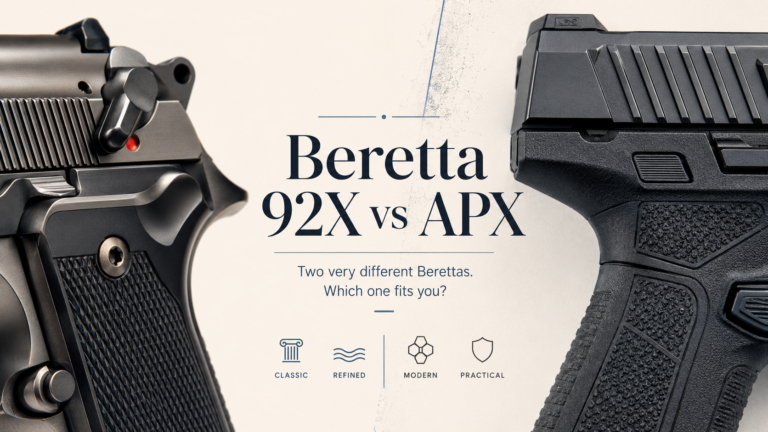
    Beretta 92X vs. APX A1: Expert Comparison from Behind the Counter

    g4gguns/
    May 20, 2026

    If you’ve narrowed your handgun search down to Beretta — first of all, good taste. Beretta has been making firearms for five hundred years, and the company’s craftsmanship and engineering are some of the best in the industry. But once you’re shopping Beretta, you almost immediately run into a fork in the road: the 92X vs APX A1.

    Both are full-size 9mm handguns. Both are made by the same company. Both have devoted fans. And they could not be more different from each other.

    This is the conversation we have at the counter when someone comes in asking which one to buy. Here’s the honest version, written down.

    The short version

    If you want the quickest possible answer:

    • The 92X is for shooters who want a refined, hammer-fired, all-metal-frame 9mm with deep heritage, exceptional accuracy, and a shooting experience that feels like a piece of fine machinery. It’s the modern evolution of the gun that served as the U.S. military’s M9 for thirty-plus years. Heavier, more expensive, more romantic.
    • The APX A1 is for shooters who want a modern, striker-fired, polymer-frame 9mm at a fighting price, with everything today’s market expects — optics-ready, modular grip, ambidextrous controls, light rail. Lighter, cheaper, more practical.

    You’re not really comparing two of the same kind of thing. You’re comparing two answers to the question “what should a modern Beretta 9mm be?” — one that honors the past and one that engages with the present.

    Now, the long version.

    The 92X: The modern descendant of an icon

    The 92-series is one of the most recognizable handgun platforms in the world. If you’ve watched a Hollywood action movie in the last forty years, you’ve seen one. The U.S. military adopted the 92FS as the M9 service pistol in 1985 and used it as their sidearm until 2017. It’s the gun that defined what a “service pistol” looked like for a generation.

    The 92X is the current production refresh of that platform. Same fundamental design — short-recoil-operated, hammer-fired, single-action/double-action with an exposed barrel — but with modern updates: better ergonomics, improved trigger, beveled magazine well, updated controls, and a Vertec-style straight backstrap that fits a wider range of hands than the original 92FS curve.

    What you’re getting:

    • A full-size, full-metal 9mm with a steel slide and aluminum alloy frame (it’s heavy — about 33 ounces unloaded)
    • DA/SA action: first trigger pull is long and heavy (double-action), subsequent shots are short and light (single-action) once the hammer is cocked
    • Exposed barrel design — distinctive Beretta look, easy to inspect and maintain
    • 17-round magazine capacity in standard configuration
    • A long shooting history, deep aftermarket support, and parts available everywhere

    What it feels like to shoot: Soft. The all-metal weight soaks up recoil in a way that polymer guns simply can’t, and the bore axis (where the barrel sits relative to your hand) keeps muzzle flip low. Most shooters describe the 92X as “easy to shoot well” — meaning your groups tighten up quickly because the gun isn’t fighting you.

    The trade-off: it’s heavy. If you’re thinking concealed carry, the 92X is not your friend. This is a duty gun, a range gun, a home defense gun. Carrying 33 ounces of steel and aluminum on your hip all day is a commitment most people don’t make.

    The APX A1: Beretta’s modern striker-fired entry

    The original APX launched in 2017 as Beretta’s serious bid for the modern striker-fired market — going after the Glock, Sig P320, and Smith & Wesson M&P customers. The APX A1 is the refresh: same platform, but updated with optics-ready slide, improved trigger, redesigned grip texture, and lighter overall weight.

    This is Beretta competing in the modern market on the modern market’s terms. Striker-fired. Polymer frame. Ambidextrous controls. Optics-ready. Light rail. Everything the contemporary 9mm shopper expects in 2026.

    What you’re getting:

    • A full-size, polymer-frame 9mm with a steel slide
    • Striker-fired action: every trigger pull is consistent — no DA/SA transition to learn
    • About 27 ounces unloaded — meaningfully lighter than the 92X
    • 17-round magazine capacity in standard configuration
    • Factory optics-ready with a multi-footprint plate system (fits most popular red dots without an adapter)
    • Aggressive slide serrations front and rear, full-length accessory rail, ambidextrous slide stop and magazine release
    • A significantly lower price point than the 92X — usually $200-300 cheaper

    What it feels like to shoot: Modern, predictable, and practical. The trigger is consistent shot to shot, which makes the APX easier to learn than a DA/SA gun. The grip texture is aggressive in a good way — it stays put under recoil even with wet hands. It’s not as soft to shoot as the all-metal 92X, but it’s far from snappy. It’s a gun that gets out of the way and lets you focus on your shooting.

    The APX A1 was designed for shooters who care less about heritage and more about how a gun performs when they’re actually using it — at the range, on duty, or in a defensive context.

    Side-by-side at a glance

    Beretta 92XBeretta APX A1
    ActionHammer-fired, DA/SAStriker-fired
    FrameAluminum alloyPolymer
    Weight (unloaded)~33 oz~27 oz
    Capacity17+117+1
    Optics-readySpecific variants onlyYes, factory standard
    Light railYes (Picatinny)Yes (Picatinny)
    TriggerLong first pull, short follow-upsConsistent every pull
    Best useRange, home defense, dutyRange, home defense, duty, some concealed carry
    Price range$700-900$400-550
    HeritageDirect descendant of the M9 service pistolModern from the ground up

    The four big questions to ask yourself

    This is what we walk through with people at the counter.

    1. Do you want to learn a DA/SA trigger?

    This is the single biggest functional difference between the two guns. The 92X has a long, heavy first trigger pull (double-action) — and then every shot after that is short and light (single-action) because the hammer is cocked from the cycling slide. The APX A1 has a consistent trigger every single shot.

    A DA/SA trigger is not difficult, but it does require practice and an understanding that your first and second shots feel very different. Some shooters love this — the long first pull is a built-in safety feature, and the short follow-ups are buttery. Other shooters find it frustrating and prefer the predictability of striker-fired.

    If you’re newer to handguns or just want one less variable to manage, striker-fired (APX A1) is the simpler learning curve.

    If you’ve shot DA/SA guns before, or you’re interested in the safety advantages of a heavy first pull, the 92X rewards practice in a way the APX doesn’t.

    2. How much weight are you willing to carry, hold, or store?

    Weight changes everything about a handgun.

    The 92X’s 33-ounce all-metal frame is gorgeous at the range — it soaks up recoil, balances well in the hand, and feels substantial. But it’s a lot of gun to hold up for a long shooting session, and it’s a serious commitment if you’re considering it for any kind of concealed carry. Most people who carry concealed don’t reach for a 92X.

    The APX A1 at 27 ounces is still a full-size handgun — not pocket-pistol territory — but it’s noticeably easier to hold, handle, and (with the right setup) carry.

    If your gun is going to live in a nightstand or a range bag, weight doesn’t matter much. The 92X wins on shooting feel.

    If you might want to carry it occasionally or shoot it for long range sessions without fatigue, the APX A1 is easier to live with.

    3. Do you want optics-ready out of the box?

    Red dot sights are becoming standard on serious-use handguns, and an optics-ready slide is increasingly important for anyone thinking about adding one.

    The APX A1 is optics-ready from the factory with a multi-footprint plate system that fits most popular red dot sights without needing an adapter. This is genuinely future-proof — whatever red dot you eventually want, the APX A1 is ready for it.

    The 92X is optics-ready in specific variants only — there’s a 92X RDO model that comes optics-cut, but the standard 92X does not. If you want a red dot on a 92X, you’re either buying the RDO version or sending the slide off to be milled.

    If a red dot is in your near future, the APX A1 is the more straightforward path.

    4. What’s your budget?

    Honest pricing reality at the counter:

    • A 92X runs roughly $800 + depending on configuration.
    • An APX A1 runs roughly $400-550 (The micro variant can hit below $300)

    That’s a $200-300 gap, and what you’re paying for with the 92X is materials and heritage. The aluminum frame, the steel slide, the refined Italian manufacturing, the lineage of the M9 platform — those are real things, but they show up in the price tag.

    The APX A1 is the better value gun by most objective measures. The 92X is the better experience gun for people who want to feel the difference.

    Who buys which one

    After thirteen years of selling Beretta handguns, here are the patterns we see.

    People who buy the 92X:

    • Shooters who served with an M9 in the military and want the modern civilian equivalent
    • Beretta loyalists who appreciate the heritage and the all-metal feel
    • Shooters who already own polymer striker-fired guns and want something different — a “shooter’s pistol”
    • Home defense buyers who want the heft and want the long first pull as a layered safety feature
    • Competition and target shooters who appreciate the accuracy potential and softer recoil

    People who buy the APX A1:

    • First-time handgun buyers who want a modern, practical, optics-ready gun at a reasonable price
    • Shooters who came in looking at Glocks or Sigs and discovered the APX outperforms them in several categories at a lower price
    • Buyers who want one full-size do-everything gun for range, home defense, and occasional carry
    • Shooters who want to mount a red dot from day one without paying for slide milling
    • Practical-minded buyers who don’t care about brand romance and just want the gun that works best for their use case

    Our honest recommendation

    If you want us to just tell you what to buy, here’s the honest version:

    Get the APX A1 if this is your only handgun or your everyday-use handgun. It’s more versatile, more affordable, optics-ready out of the box, and easier to learn. For most shooters in 2026, it’s the practical right answer.

    Get the 92X if you already have a practical handgun and you want something more. Something that connects you to a hundred years of firearm history. Something that feels like fine machinery when you pick it up. Something that rewards practice and patience. The 92X is the gun you want when you already know what you’re doing — or when you’re ready to grow into something with depth.

    Both are excellent. Beretta doesn’t make a bad handgun. The question is what kind of relationship you want with the firearm you’re about to own.

    Come handle them both

    This is the part where we say what we always say: come into the shop and handle them. A blog post can tell you the specs, the action types, and the price difference. But the moment you pick up a 92X — feel the weight, the balance, the way it settles into your hand — and then pick up an APX A1 right after, you’ll know within thirty seconds which one is calling to you.

    We’ve got both. Stop in. We’ll let you handle them, dry-fire them safely, talk through whichever questions come up, and help you figure out which Beretta is the right Beretta for you.

    We promise: there are no wrong answers in this comparison. Just different ones.
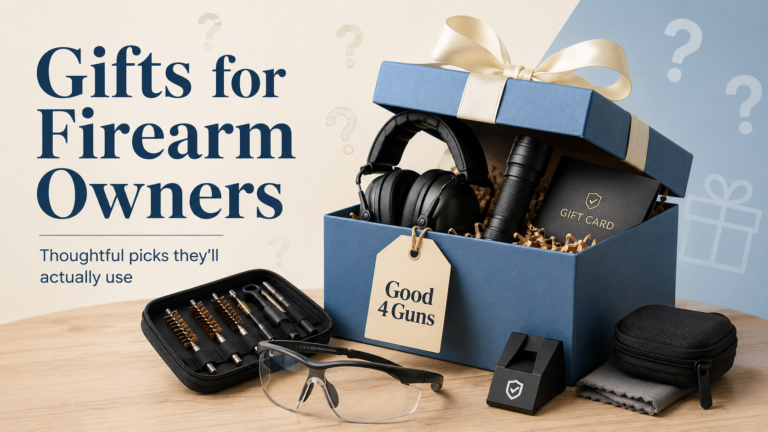
  • Gifts for Gun Owners Good 4 Guns

    Great Gifts for Someone Who Just Got Their First Gun

    g4gguns/
    May 19, 2026

    So someone you love just got their first gun, and now you’re sitting at your computer trying to figure out what to get them for their birthday, their anniversary, Father’s Day, Christmas, or just because. Maybe you don’t know much about firearms. Maybe you’re not sure where to start. You don’t want to get them something dumb, and you really don’t want to get them something dangerous.

    You’re in the right place. We help people pick out gifts for first-time gun owners all the time — and we’ve watched what works, what gets used, and what ends up in the bottom of a drawer.

    Here’s the honest, curated, no-nonsense version of the list.

    First, a few quick rules

    Before we get into specifics, two things to know:

    You don’t have to know what gun they have. Almost everything on this list is gun-agnostic — meaning it works for their first handgun, their first shotgun, or whatever they ended up with. You don’t need to know calibers or models. You just need to know they got into shooting.

    This guide assumes they’ve already got their gun. This is about what they need next — the gear, the gifts, the things that make their new hobby easier, safer, and more fun. The things they don’t know they need yet, or haven’t gotten around to buying for themselves.

    Now, the list.

    Under $25: The “Stocking Stuffer” Tier

    These are the small, useful, “oh, I’m glad I have this” gifts. Perfect on their own for a birthday card add-on, or grouped together to build a bigger gift basket.

    Quality eye protection. Every shooter needs safety glasses, and a lot of new shooters are still using whatever the range had to rent them on their first trip. A pair of comfortable, ANSI Z87.1-rated safety glasses is something they’ll use every single time they shoot. Pick a style that’s not bulky — most people prefer something they don’t feel ridiculous wearing.

    Foam ear plugs in bulk. Sounds boring. Isn’t. Quality foam plugs are the unsung hero of every range trip, and most people don’t keep enough of them on hand. A bulk pack of NRR 32+ plugs goes a long way. Most people end up using them for all kinds of things outside the range and will quietly think to themselves “I’m so glad so and so bought me these. What a rockstar.”

    A range bag patch or sticker. Personalization is underrated. A patch with their state, their unit, their favorite firearm manufacturer, their dog — something that turns their generic range bag into theirs. (We’ve got some good ones at the shop.)

    Under $50: The “Actually Useful” Tier

    This is where the gifts start to feel substantial, and where you get the best value-per-dollar on this list.

    A basic cleaning kit. Every gun owner needs one. A lot of first-time owners don’t have one yet because they forgot to buy it when they bought the gun. A universal cleaning kit covers them across most common calibers and includes everything they need to maintain their firearm properly. Bonus: cleaning the gun is one of the small rituals that builds confidence and connection with a firearm, so this is a gift that actually deepens their hobby.

    Electronic ear muffs. Around the $40-60 range, you can find a solid pair of electronic ear muffs that block gunshot noise but let normal conversation through. This is a significant upgrade from foam plugs alone and one of the most-appreciated gifts in this category. Anyone who’s been to a range with passive-only protection will instantly understand the  value of this upgrade.

    A range bag. A good range bag is the difference between “I show up to the range with a Walmart sack” and “I’m an organized adult.” Look for something with separate compartments for the gun, magazines, ammo, and ear/eye protection. Doesn’t have to be tactical-looking — plenty of great options look like regular bags.

    Under $100: The “Wow, This Is Thoughtful” Tier

    These gifts feel substantial and signal that you really put thought into what they’d want. Reserved for the people you really like.

    The G4G Quick Reload Bundle. This one’s our specialty. Running out of loaded magazines is the #1 thing that ends a range session early — and most new shooters show up with one magazine, fumble-loading it round-by-round between strings. A Quick Reload Bundle solves that. We’ll put together a curated set for your person: a box of quality range ammo, a spare magazine for their gun, and a speed loader (or magazine pouch, depending on what their gun needs). Walk in, tell us what they shoot, and we’ll build it. It’s the kind of gift that gets used every single range trip — and the kind of gift that turns a frustrating range session into a great one. (Caveat- you do need to know what firearm they have for us to help you here, this one can’t be guessed at.)

    Manufacturer-branded merch from their favorite brand. A Glock cap, a Sig hoodie, a Walther tee, a Beretta tumbler — shooters who love their gun love showing it, and most of them wouldn’t buy this stuff for themselves. It’s pure gift territory. If you’ve heard them mention a specific manufacturer’s name with affection, that’s your tell. A hat-and-shirt combo lands beautifully in this tier and feels like a real “I was paying attention” gift.

    A range gift card or membership. If they have a local range they like, a punch card or membership gets used immediately. If they’re still range-shopping, a more general gift card works too. Range time is the thing every new shooter wants more of, and it’s the gift that turns a new gun owner into a confident one. Bonus: it’s a gift that builds a habit, not a clutter pile. This one is perfect for your “I already have enough stuff” loved ones.

    A cleaning gear upgrade. If they’ve already got a basic cleaning kit (or you suspect they do), the upgrade tier is where things get really nice — a quality bench mat that catches all the solvent and small parts, a real chemical kit beyond the bargain-bin stuff, a multi-caliber bore snake set, a proper cleaning rod. For the shooter who’s starting to take maintenance seriously, this is the kind of gift that makes them feel like a real gun owner instead of someone winging it. Ask us — we can put together an upgrade kit at this price point easily.

    Under $200: The “I Love You” Tier

    This is where you can really make their year.

    A quality holster. If they carry concealed and if you can find out what gun they have, a good kydex holster is one of the most personal and useful gifts you can give them. Most quality holsters run $60-100, leaving plenty of room for additional gear. In this price range you can even spring for two so they have options. Just be aware that holster fit is personal — if you can’t pry the gun model out of them, this might be a gift card situation.

    A quality, biometric small lock box. First-time gun owners often haven’t yet invested in proper secure storage, and a quality biometric quick-access lock box (around $150-200 for a good one) solves a real problem. This is especially meaningful if they have kids in the house. This is often one of those things new gun owners are well intentioned about but gets lost in the noise and the gesture is always received appreciatively.

    A first aid / trauma kit. Hear us out. Anyone who shoots regularly should have a basic trauma kit on hand. A quality boo-boo kit + trauma kit combo is something every gun owner should own and most don’t. It’s not a romantic gift, but it’s a real one, and the person who receives it will eventually be very glad they have it. That’s not to say the worst will happen- but everyone has experienced the pain of slide bite, hot round burns, etc. Plus it’s useful well beyond the range. I can’t tell you how often I reach into ours to grab burn cream after a cooking experience goes south.

    A quality compact spotting scope. Here’s a gift most people don’t think of, and shooters love. A good compact spotting scope (around $100 for a good one) lets them check their groups at the range without walking down to the target every five shots — which sounds minor until you realize how much it improves a range session. For rifle shooters, it’s borderline essential. For handgun shooters, it’s a luxury that becomes a favorite. Bonus: it doubles as a hiking, hunting, and bird-watching tool, so even on the days they’re not at the range, it earns its keep.

    The Splurge Tier: $200+

    If your budget allows, here’s where the truly memorable gifts live.

    A quality safe. A proper full-size or under-bed safe is a serious investment, but it’s the kind of gift that becomes part of the household for decades. If they’re storing multiple firearms or expanding their collection, this is the gift that says I take this seriously and I want you to as well.

    A training course. This is, hands down, the gift that produces the biggest growth in a new gun owner. A defensive handgun fundamentals course, a women’s-only intro course, or a hands-on training day with a qualified instructor is worth ten range trips. It changes how they shoot, how confident they feel, and how safely they carry. Around the $150-400 range depending on the program. Ask us — we know the local instructors and can point you toward someone who’ll teach the way your person learns.

    A Good 4 Guns gift card. We say this without irony: a gift card to a friendly, local gun shop is one of the best gifts on this list. Especially for someone newer to firearms. It means they walk into the shop, get treated like a person (not a transaction), and pick out exactly what they need with someone helping them. We don’t upsell. We don’t push. We help them figure out what works for them. And every Good 4 Guns gift card is part of a chain of customer relationships we’ve been building for thirteen years.

    A few things not to get them

    Most gift guides won’t tell you this part. We will.

    Skip the “tactical” gimmick gifts. Tactical pens, tactical multi-tools, tactical anything-that’s-not-actually-a-tactical-thing — these almost always end up in a drawer. They’re designed for gift-guide listicles, not actual use.

    Skip the novelty items. Whiskey glasses with bullet shapes pressed into them, AR-15-shaped bottle openers, Don’t Tread On Me coffee mugs. If your person is into these, they probably already have them. If they’re not, you don’t want to be the one who gave them a flag-print coozie.

    Skip “survival” anything they didn’t ask for. Paracord bracelets, fire starters, freeze-dried emergency food — unless your person is specifically into prepping or hiking, these miss the mark.

    Ammunition is actually a great gift — with one caveat. Most shooters are happy to have someone else cover a range session worth of ammo. Just buy quality stuff in their caliber (we can help) and skip the bargain-bin reloaded ammo. The one exception: if your person is the kind of shooter who reloads their own ammo or talks about specific grain weights and bullet brands by name, they’re picky enough that you should default to a gift card and let them choose. If they’ve never said the words “147 grain” in your presence, you’re safe to just buy them ammo.

    Don’t buy a gun safe that’s too small to grow into. A small lockbox is great for one or two firearms. If they’re already accumulating, get the bigger size. They will fill it. They always do.

    When in doubt, ask us

    Honest truth: the best gift for a first-time gun owner is something they’ll actually use, that fits their gun and their life. If you’re not sure, come into the shop and tell us about them. Tell us what they shoot, what they’re into, what they need, and what your budget is. We’ll walk you through real options — no upsell, no pressure, no judgment about what you do or don’t know about firearms.

    We do this all the time. We love helping people pick out gifts for the people they love. It’s one of the most fun parts of the job. And we promise: nobody on our team will ever make you feel dumb for not knowing what your spouse’s gun is called.

    You’re already doing the most important part — thinking carefully about what would make them happy.

    We can help with the rest.

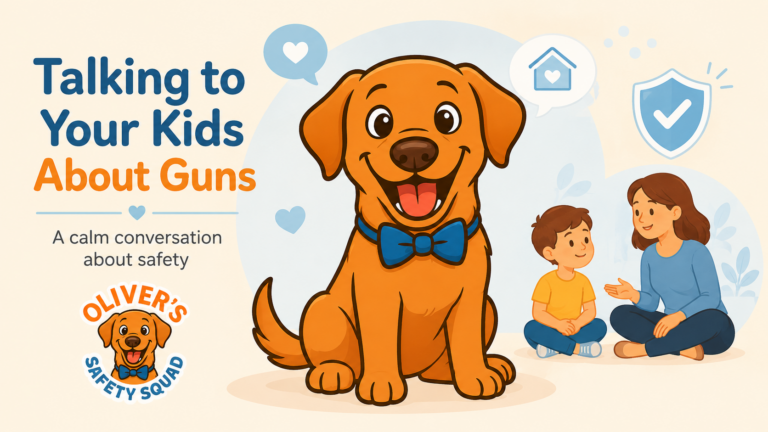
  • Oliver and talking to kids about gun safety

    Guns and Kids: How to Talk About Firearm Safety with Your Family

    g4gguns/
    May 14, 2026

    Whether you own firearms or not, your kids are going to encounter them eventually. At a friend’s house, at a grandparent’s house, on TV, in a video game, in a movie, on a field trip to a museum, in a hunting story from a classmate, somewhere. Pretending guns don’t exist doesn’t make them disappear from a child’s life — it just makes you not the one explaining them.

    This is the conversation we wish more parents had with their kids, regardless of whether there’s a gun in the house. It’s not political. It’s not scary. It’s not complicated. And it might be one of the most important conversations you ever have.

    Here’s how we approach it.

    Start by not making it taboo

    This is the part most people get wrong, in both directions.

    Some parents treat firearms as something kids should never hear about, never see, never discuss. The idea is that ignorance equals safety — if my child doesn’t know guns exist, they won’t go looking for one. The problem is that ignorance isn’t always bliss. A child who has never been told what a gun is, what it does, and what to do when they see one is exactly the child who, when they find one at a friend’s house, will pick it up to see what it does.

    Other parents treat firearms casually — leaving them accessible, showing them off, not building a clear framework around them. We don’t agree with that one either. A child who sees a gun treated like just another object on a shelf doesn’t learn that it requires special respect and special caution.

    The middle path was the right one for us: talk about guns openly, calmly, and matter-of-factly — and back the conversation up with secure storage. Knowledge alone isn’t safety. Storage alone isn’t enough either. You need both.

    When we started carrying, we sat our then-five-year-old son and six-year-old daughter down at the kitchen table, with the firearm unloaded in front of us, and we explained it. What it was. Why we had it. Why it wasn’t a toy. Why they were never to touch it without us. Why we kept it locked up. We made it ordinary and serious at the same time — the same way you might talk about a hot stove or a busy street. Not scary. Not exciting. Just real.

    Then we showed them the Eddie Eagle videos from the NRA, which are made specifically for young children and teach a simple, four-word rule:

    Stop. Don’t touch. Run away. Tell a grown-up.

    That’s the rule. That’s the whole lesson for a small child. If you see a gun anywhere — at a friend’s house, at the playground, in a relative’s drawer — Stop. Don’t touch. Run away. Tell a grown-up. Four directions a four-year-old can remember.

    You don’t have to be an NRA member, or even a gun owner, to use that script with your kids. It works. Use it. The videos are free, still accessible on YouTube, and still cute enough to keep most small kids’ attention.

    The conversation looks different at different ages

    A four-year-old needs the Eddie Eagle rule. A fourteen-year-old needs something different. Here’s roughly how we’d think about it.

    Ages 3-7: The Simple Rule

    At this age, kids don’t need explanations of mechanisms, calibers, or use cases. They need a clear, repeatable safety rule. That’s it.

    • Show them Eddie Eagle videos (free on YouTube)
    • Practice the rule out loud occasionally, the same way you practice “stop, drop, and roll” or “look both ways”
    • Be matter-of-fact about it. No drama, no fear, no excitement
    • If you have firearms in the home, they should know there are “grown-up things” in the house that are off-limits, locked up, and only handled by grown-ups

    Ages 8-12: Context and Curiosity

    Now the questions get bigger. Why do we have it? How does it work? What’s it for? This is the age where kids absorb mechanical and procedural information well, and where their curiosity needs honest answers — because if you don’t give them, they’ll find answers somewhere else (the internet, friends, video games), and those sources aren’t always accurate.

    • Answer questions honestly and matter-of-factly
    • Introduce the four universal safety rules if they’re old enough to understand them:
      1. Treat every gun as if it’s loaded
      2. Never point a gun at anything you’re not willing to destroy
      3. Keep your finger off the trigger until you’re ready to shoot
      4. Be sure of your target and what’s beyond it
    • Continue to reinforce: knowledge does not equal access. Even kids who understand firearms aren’t allowed to handle them without a parent present
    • This is a good age to take them to a range with you, if they’re interested and if your range allows it. Supervised exposure builds respect. (Small note here- we hear LOTS of stories about the parents who take their kids or wives or friends to the range and immediately hands them the heaviest caliber they own as the first thing they fire. That’s… really not cool. Don’t do that. Everyone who hears that story who ISN’T that guy really doesn’t like that guy. Especially the kids, wives, girlfriends, and friends on the other end of that joke.)

    Ages 13+: Participation and Responsibility

    Teenagers can begin to participate more directly — at the range, in cleaning and maintenance, in real conversations about responsibility, storage, and the legal and ethical weight of firearm ownership. They’re also at the age where peer environments matter most, and where the conversation about what to do at a friend’s house becomes critically important.

    • Have an explicit, age-appropriate conversation about what to do if they’re at a friend’s house and a gun comes out — even casually. The answer: leave, and tell you
    • If you’re a hunter or a shooter, this is a great age to invite them into the activity in a real way if they’re interested
    • Storage rules don’t change. A teenager who has been trained on a firearm still shouldn’t have unsupervised access to it. These are tough years, you don’t know what their friends have been (or haven’t been) taught about firearms, and a million other reasons this is a bad idea I won’t list off here.

    What to do about other people’s houses

    This is the question we get asked most often, and it’s the one most parents are most worried about: “What if my child goes to a friend’s house and there’s a gun there I don’t know about?”

    The honest answer: this is a real concern, and you have two tools to address it.

    Tool one: know the people whose home your child is going into. This one wasn’t important when I was a kid, and half the people my age can tell you stories about why it’s important now. It was not uncommon to have zero knowledge about the adults in the homes of our friends when I was growing up. This is another one of those “million reasons why this is a bad idea” topics. Know the adults. Know their names. Do you even like them? Does your child like them? Would you have wanted to spend time with them when you were a child?

    Tool two: teach your child the rule, every time. No matter how thoroughly you’ve vetted a household, the only true safety net is your own child knowing what to do. Reinforce Eddie Eagle. Reinforce the four safety rules. Make sure your kid knows that the correct response to seeing a gun at a friend’s house is the same as it always is: stop, don’t touch, leave the room, find a grown-up — and tell us when you get home.

    There is no embarrassment in that response. There is no overreaction in that response. That’s the response that keeps kids alive.

    Knowledge is not enough — storage is the other half

    This is the part of the conversation that gets undersold in a lot of gun-owning households, and we want to be very direct about it.

    Educating your child about firearms does not mean you should leave firearms accessible to them. Those are two different conversations and they are both necessary.

    Our kids knew about our firearms from the time they were five and six years old. They could tell you what was in the house. They could recite the safety rules. And every single one of those firearms was still locked up, secured, and out of their access at all times.

    Why? Because kids are kids. Kids have bad days, curious moments, friends over, dares to navigate, brains that are still developing impulse control. The whole point of secure storage is to make sure that on the worst day — the day when knowledge alone isn’t enough — the firearm simply isn’t reachable.

    A few storage principles we’d recommend regardless of how well-trained your kids are:

    • We kept the ammunition inaccessible too so they don’t end up in pockets, at school, or anywhere else that could get them in trouble or injured
    • A quality safe or lockbox, biometric or combination — not a “hidden” location
    • Defensive firearms in a quick-access safe if needed for home defense (these exist; they open in seconds for you and never for anyone else)
    • Trigger locks as a backup layer for safe queens, not as a primary security measure
    • Check storage regularly. Lockboxes get bumped. Safes get left open. Make sure the system is actually functioning

    If you’d like specific recommendations on safes or storage solutions for your situation, that’s exactly the kind of conversation we love having at the shop. Stop by, tell us about your home, your kids’ ages, and what you’re trying to secure, and we’ll point you toward what works.

    A few things you don’t have to do

    If you’re feeling overwhelmed by this conversation, here’s what isn’t required:

    • You don’t have to be a “gun person” to talk to your kids about firearm safety. Eddie Eagle is for every kid, gun-owning home or not
    • You don’t have to have one perfect, formal conversation. Safety conversations work better as ongoing, low-pressure check-ins, not One Big Talk
    • You don’t have to have all the answers. If your kid asks something you don’t know, “I’m not sure, let’s find out together” is a perfectly good answer
    • You don’t have to make the conversation political. Firearm safety is not a left or right issue. It’s a parenting issue.

    The bottom line

    Talk to your kids. Not once — over time, in small pieces, in calm voices, in language they can understand. Teach them the rule. Reinforce it casually until it’s second nature. If you own firearms, lock them up — every time, every day, without exception. Ask other parents about their homes. And trust your kid with the information they need to make a good decision when you’re not there.

    The goal isn’t to make your child afraid of firearms. It’s to make them informed, calm, and equipped to make safe choices in every situation life puts them in. That’s true whether they grow up to be a hunter, a competitive shooter, a casual range-goer, or someone who never picks up a firearm in their life.

    It’s just one more thing we teach our kids about how to navigate the world safely.

    A program we’re proud of: Oliver’s Safety Squad

    We can’t write a post about kids and safety without mentioning what we’ve built ourselves. Oliver’s Safety Squad is our children’s coloring book series, starring our shop dog Oliver and his lamb Clover. Each book covers age-appropriate safety topics in a calm, story-based format for kids ages 4-8 — outdoor hazards, holiday safety, the responsibility of caring for an animal, and the underlying habit of stop, think, check with a grown-up before doing something uncertain.

    The books aren’t a substitute for the conversation in this article. They’re a companion to it. Kids respond to characters and stories in a way that pure rule-recitation can’t reach, and Oliver has become a quiet bridge between parents and kids on topics that can otherwise feel hard to bring up.

    Pick one up next time you’re in the shop. They’re free, and we’d rather a copy be in your kid’s hands than on our shelf.

    If you need help having this conversation

    We’ve talked a lot of parents through this — whether they own firearms or not. If you’re not sure how to bring it up, what to say, what age to start, or what storage solution makes sense for your household, come by and ask. No purchase necessary. No pressure. We’re parents too. We get it.

0
    0
    Your Cart
    Your cart is emptyReturn to Shop