Category: New Here?

  • Concealed Carry Summer Heat

    Summer Concealed Carry in Texas: How to Carry When It’s 104 Degrees

    g4gguns/
    May 26, 2026

    There’s a stretch of the year in North Texas where the heat stops being weather and starts being a personality. You walk to your truck and the steering wheel tries to brand you. The dog refuses to go outside until sundown. And if you carry concealed, the season brings a very specific problem that nobody warned you about when you bought your first gun: how do you actually hide a firearm when you’re wearing shorts and a t-shirt?

    It’s one of the most common questions we get across the counter once summer hits. Folks who carried comfortably all winter under a jacket suddenly feel like the whole thing is impossible in July. The good news is that it isn’t. People carry concealed in brutal heat all over the South, every single day, and most of them figured it out through trial and error and a little advice from someone who’d been there.

    This is that advice. No lectures, no “well actually,” just the practical stuff that actually helps when the temperature has a comma in it.

    A quick note before we start This guide is about comfort and practicality, not the law. If you’re still sorting out whether you need a License to Carry, what the signage rules are, or where you can and can’t carry in Texas, start with our full Texas concealed carry guide first — then come back here for the summer-specific stuff.

    Why Summer Is Genuinely Harder (You’re Not Imagining It)

    Winter carry is easy mode, and most people don’t realize it until it’s gone. A jacket, a flannel, a hoodie — any of them will swallow a full-size handgun and never tell a soul. You get spoiled. Then summer arrives and takes away your cover garment, your waistband real estate, and your patience all at once.

    There are three things working against you in the heat, and naming them makes them a lot easier to solve:

    • Less fabric. Thin cotton and athletic wear print far more easily than denim and wool. The outline of the gun shows through.
    • More movement. You’re more active in summer — reaching, bending, getting in and out of a hot vehicle — and lighter clothing shifts more, which means your setup has to actually stay put.
    • Sweat. Nobody likes to talk about it, but a steel slide against bare skin all day is a comfort and corrosion problem. It’s solvable, but you have to plan for it.

    Every recommendation in this guide is really just a way of answering one of those three problems. Once you see it that way, the gear conversation gets a lot less overwhelming.

    Strategy One: Carry a Smaller Gun (At Least Sometimes)

    This is the simplest lever you can pull, and it’s the one people resist the most. If you carry a full-size duty pistol all winter, summer is a reasonable time to consider a smaller everyday option. A compact or micro-compact prints less, weighs less, and forgives lighter clothing in a way a larger gun simply won’t.

    This isn’t about “downgrading.” Plenty of people run a two-gun rotation — a larger pistol for cooler months or open-cover days, and a slimmer one for the dead of summer. The micro-compact category has gotten genuinely good over the last few years, and a gun you’ll actually carry beats a bigger gun that lives in the safe from June to September because it’s a pain to conceal.

    If you’re thinking about adding a summer carry gun to the rotation, our honest comparison of the most popular concealed carry pistols is a good place to start — it’s written by people who sell all of them and don’t have a dog in the fight.

    The honest version We’re not going to tell you the gun you already own is wrong. If it conceals fine for you in summer, keep carrying it. A second smaller gun is an option, not a requirement — and it’s a real cost. Don’t let anyone shame you into a purchase you don’t need.

    Strategy Two: Rethink Where You Carry It

    Carry position matters more in summer than any other time of year, because position is what decides whether a thin shirt gives you away. Here are the realistic options and the honest tradeoffs of each — not a sales pitch, just what tends to work in the heat.

    PositionWhy it works in summerThe tradeoff
    Appendix (AIWB)Conceals very well under an untucked t-shirt; the gun sits flat against the body and is easy to cover.Takes practice to find a comfortable, safe setup. Not everyone’s body type loves it. Worth trying before committing.
    Strong-side IWBThe classic, most forgiving for most people. Hides well under an untucked shirt at the 3–4 o’clock position.Can print when you bend or reach. A slightly looser shirt solves most of it.
    Pocket carryGenuinely useful for the smallest guns when you’re in shorts or athletic wear with no belt.Only works with a true pocket-size gun and a dedicated pocket holster. Slower to access.
    Belly band / waistband wrapCarries without a belt — perfect for gym shorts, athletic pants, and “I’m not wearing a real waistband today” situations.Less stable than a rigid holster and can get warm. A good one is worth the money; a cheap one isn’t.

    A note on holsters: Good 4 Guns doesn’t sell holsters, so we’ve got no reason to push you toward any particular brand. What we’ll tell you is the same thing we tell people at the counter — a quality holster that fully covers the trigger guard and holds the gun securely is one of the most important purchases you’ll make, and it’s not the place to save twenty dollars. Whatever position you choose, get a holster built for your specific gun.

    Strategy Three: Dress Around the Gun

    You don’t have to dress like you’re going on a cartel raid to conceal in summer. Small, normal wardrobe choices do almost all of the work, and none of them look tactical:

    • Pick prints and patterns. A patterned shirt breaks up the outline of a gun far better than a solid color. A plain white tee is the hardest thing to conceal under; a patterned camp shirt is one of the easiest.
    • Go one size looser on top. Not baggy — just not skin-tight. A shirt that skims the body instead of clinging to it hides a waistband gun without looking like you’re hiding anything. And to be honest… it allows for better air flow in the heat.
    • SLIGHTLY darker over light. Darker shirts show printing and sweat less than light ones. Be careful with this one though, because they also absorb heat faster.
    • The untucked camp shirt is your best friend. Short-sleeve, slightly structured, worn open over a tee or on its own — it’s breathable, looks completely normal in Texas summer, and conceals a waistband gun beautifully.

    Strategy Four: Deal With the Sweat Honestly

    This is the part most guides skip, and it’s the part that actually drives people to stop carrying in summer. Here’s the straight talk.

    A handgun riding against sweaty skin all day will rust if you ignore it. It’s not dramatic and it’s not instant, but it’s real. The fix is simple: wipe the gun down at the end of the day, and keep up with light maintenance through the summer months. If it’s been a hot, sweaty week, give it a quick clean and a wipe of oil — it takes five minutes.

    If you want a refresher on doing it right, our handgun cleaning walkthrough covers it step by step. For summer specifically, the move is more frequent light maintenance rather than one big cleaning — a quick wipe-down beats letting sweat sit. (One of us has a regular carry piece that is copper plated- guess which one- and it will literally form salt crystals if not cared for properly in the summer.)

    On the comfort side: a holster with a sweat guard or backer keeps the slide off your skin, which solves most of the discomfort and a good chunk of the corrosion problem at the same time. An undershirt does the same job in a pinch. Stainless and modern coated finishes handle moisture better than older blued guns, but none of them are immune — so just stay on top of it.

    The five-minute summer habit End of the day, gun comes off: a quick wipe-down with a clean cloth, a thin pass of oil on the slide, done. Do that consistently and summer carry never becomes a corrosion problem. Skip it for three sweaty months and you’ll see the difference.

    A Few Real-World Situations

    The pool, the lake, the river. Swimming and carrying don’t mix, so plan for storage. A locked container in the vehicle is far better than leaving a gun loose in a glovebox or, worse, in a bag on a towel. Think about this before you go, not in the parking lot.

    The hot car. A closed Texas vehicle in July is an oven, and that’s hard on ammunition and optics over time. Don’t make your car your permanent gun storage. If you have to leave it, leave it secured and don’t make a habit of it.

    Outdoor work and yard days. This is where a belly band or pocket setup earns its keep — you can carry without a belt while you’re sweating through chores, and it stays put while you move. Dog them all you want- but the belly bags are back for men and women both- let fashion work for you here and find a good one for moments like this.

    Cookouts and gatherings. Lighter, smaller, well-concealed is the whole game here. Nobody at the barbecue needs to know, and with a patterned shirt and a compact gun, nobody will.

    The Bottom Line

    Summer carry in Texas isn’t about white-knuckling through the heat or buying a closet full of tactical gear. It’s about making a few small adjustments — maybe a slimmer gun, definitely a smart carry position, a patterned shirt, and a five-minute end-of-day habit. Do those things and carrying in 104-degree weather stops being a problem you dread and goes back to being something you just do.

    And if you’re standing in your closet in June feeling like none of this is working, that’s exactly the kind of thing we’re here for. Come see us in Van Alstyne, or send us an email. We’ve all solved this for ourselves, and we’re happy to walk you through what worked — no pressure, no judgment, no upsell you didn’t ask for.

    Got a summer carry question we didn’t cover? Stop by the shop — we’d genuinely rather you ask than guess.

    Good 4 Guns · Van Alstyne, TX · g4gusa.com
  • Oliver and talking to kids about gun safety

    Guns and Kids: How to Talk About Firearm Safety with Your Family

    g4gguns/
    May 14, 2026

    Whether you own firearms or not, your kids are going to encounter them eventually. At a friend’s house, at a grandparent’s house, on TV, in a video game, in a movie, on a field trip to a museum, in a hunting story from a classmate, somewhere. Pretending guns don’t exist doesn’t make them disappear from a child’s life — it just makes you not the one explaining them.

    This is the conversation we wish more parents had with their kids, regardless of whether there’s a gun in the house. It’s not political. It’s not scary. It’s not complicated. And it might be one of the most important conversations you ever have.

    Here’s how we approach it.

    Start by not making it taboo

    This is the part most people get wrong, in both directions.

    Some parents treat firearms as something kids should never hear about, never see, never discuss. The idea is that ignorance equals safety — if my child doesn’t know guns exist, they won’t go looking for one. The problem is that ignorance isn’t always bliss. A child who has never been told what a gun is, what it does, and what to do when they see one is exactly the child who, when they find one at a friend’s house, will pick it up to see what it does.

    Other parents treat firearms casually — leaving them accessible, showing them off, not building a clear framework around them. We don’t agree with that one either. A child who sees a gun treated like just another object on a shelf doesn’t learn that it requires special respect and special caution.

    The middle path was the right one for us: talk about guns openly, calmly, and matter-of-factly — and back the conversation up with secure storage. Knowledge alone isn’t safety. Storage alone isn’t enough either. You need both.

    When we started carrying, we sat our then-five-year-old son and six-year-old daughter down at the kitchen table, with the firearm unloaded in front of us, and we explained it. What it was. Why we had it. Why it wasn’t a toy. Why they were never to touch it without us. Why we kept it locked up. We made it ordinary and serious at the same time — the same way you might talk about a hot stove or a busy street. Not scary. Not exciting. Just real.

    Then we showed them the Eddie Eagle videos from the NRA, which are made specifically for young children and teach a simple, four-word rule:

    Stop. Don’t touch. Run away. Tell a grown-up.

    That’s the rule. That’s the whole lesson for a small child. If you see a gun anywhere — at a friend’s house, at the playground, in a relative’s drawer — Stop. Don’t touch. Run away. Tell a grown-up. Four directions a four-year-old can remember.

    You don’t have to be an NRA member, or even a gun owner, to use that script with your kids. It works. Use it. The videos are free, still accessible on YouTube, and still cute enough to keep most small kids’ attention.

    The conversation looks different at different ages

    A four-year-old needs the Eddie Eagle rule. A fourteen-year-old needs something different. Here’s roughly how we’d think about it.

    Ages 3-7: The Simple Rule

    At this age, kids don’t need explanations of mechanisms, calibers, or use cases. They need a clear, repeatable safety rule. That’s it.

    • Show them Eddie Eagle videos (free on YouTube)
    • Practice the rule out loud occasionally, the same way you practice “stop, drop, and roll” or “look both ways”
    • Be matter-of-fact about it. No drama, no fear, no excitement
    • If you have firearms in the home, they should know there are “grown-up things” in the house that are off-limits, locked up, and only handled by grown-ups

    Ages 8-12: Context and Curiosity

    Now the questions get bigger. Why do we have it? How does it work? What’s it for? This is the age where kids absorb mechanical and procedural information well, and where their curiosity needs honest answers — because if you don’t give them, they’ll find answers somewhere else (the internet, friends, video games), and those sources aren’t always accurate.

    • Answer questions honestly and matter-of-factly
    • Introduce the four universal safety rules if they’re old enough to understand them:
      1. Treat every gun as if it’s loaded
      2. Never point a gun at anything you’re not willing to destroy
      3. Keep your finger off the trigger until you’re ready to shoot
      4. Be sure of your target and what’s beyond it
    • Continue to reinforce: knowledge does not equal access. Even kids who understand firearms aren’t allowed to handle them without a parent present
    • This is a good age to take them to a range with you, if they’re interested and if your range allows it. Supervised exposure builds respect. (Small note here- we hear LOTS of stories about the parents who take their kids or wives or friends to the range and immediately hands them the heaviest caliber they own as the first thing they fire. That’s… really not cool. Don’t do that. Everyone who hears that story who ISN’T that guy really doesn’t like that guy. Especially the kids, wives, girlfriends, and friends on the other end of that joke.)

    Ages 13+: Participation and Responsibility

    Teenagers can begin to participate more directly — at the range, in cleaning and maintenance, in real conversations about responsibility, storage, and the legal and ethical weight of firearm ownership. They’re also at the age where peer environments matter most, and where the conversation about what to do at a friend’s house becomes critically important.

    • Have an explicit, age-appropriate conversation about what to do if they’re at a friend’s house and a gun comes out — even casually. The answer: leave, and tell you
    • If you’re a hunter or a shooter, this is a great age to invite them into the activity in a real way if they’re interested
    • Storage rules don’t change. A teenager who has been trained on a firearm still shouldn’t have unsupervised access to it. These are tough years, you don’t know what their friends have been (or haven’t been) taught about firearms, and a million other reasons this is a bad idea I won’t list off here.

    What to do about other people’s houses

    This is the question we get asked most often, and it’s the one most parents are most worried about: “What if my child goes to a friend’s house and there’s a gun there I don’t know about?”

    The honest answer: this is a real concern, and you have two tools to address it.

    Tool one: know the people whose home your child is going into. This one wasn’t important when I was a kid, and half the people my age can tell you stories about why it’s important now. It was not uncommon to have zero knowledge about the adults in the homes of our friends when I was growing up. This is another one of those “million reasons why this is a bad idea” topics. Know the adults. Know their names. Do you even like them? Does your child like them? Would you have wanted to spend time with them when you were a child?

    Tool two: teach your child the rule, every time. No matter how thoroughly you’ve vetted a household, the only true safety net is your own child knowing what to do. Reinforce Eddie Eagle. Reinforce the four safety rules. Make sure your kid knows that the correct response to seeing a gun at a friend’s house is the same as it always is: stop, don’t touch, leave the room, find a grown-up — and tell us when you get home.

    There is no embarrassment in that response. There is no overreaction in that response. That’s the response that keeps kids alive.

    Knowledge is not enough — storage is the other half

    This is the part of the conversation that gets undersold in a lot of gun-owning households, and we want to be very direct about it.

    Educating your child about firearms does not mean you should leave firearms accessible to them. Those are two different conversations and they are both necessary.

    Our kids knew about our firearms from the time they were five and six years old. They could tell you what was in the house. They could recite the safety rules. And every single one of those firearms was still locked up, secured, and out of their access at all times.

    Why? Because kids are kids. Kids have bad days, curious moments, friends over, dares to navigate, brains that are still developing impulse control. The whole point of secure storage is to make sure that on the worst day — the day when knowledge alone isn’t enough — the firearm simply isn’t reachable.

    A few storage principles we’d recommend regardless of how well-trained your kids are:

    • We kept the ammunition inaccessible too so they don’t end up in pockets, at school, or anywhere else that could get them in trouble or injured
    • A quality safe or lockbox, biometric or combination — not a “hidden” location
    • Defensive firearms in a quick-access safe if needed for home defense (these exist; they open in seconds for you and never for anyone else)
    • Trigger locks as a backup layer for safe queens, not as a primary security measure
    • Check storage regularly. Lockboxes get bumped. Safes get left open. Make sure the system is actually functioning

    If you’d like specific recommendations on safes or storage solutions for your situation, that’s exactly the kind of conversation we love having at the shop. Stop by, tell us about your home, your kids’ ages, and what you’re trying to secure, and we’ll point you toward what works.

    A few things you don’t have to do

    If you’re feeling overwhelmed by this conversation, here’s what isn’t required:

    • You don’t have to be a “gun person” to talk to your kids about firearm safety. Eddie Eagle is for every kid, gun-owning home or not
    • You don’t have to have one perfect, formal conversation. Safety conversations work better as ongoing, low-pressure check-ins, not One Big Talk
    • You don’t have to have all the answers. If your kid asks something you don’t know, “I’m not sure, let’s find out together” is a perfectly good answer
    • You don’t have to make the conversation political. Firearm safety is not a left or right issue. It’s a parenting issue.

    The bottom line

    Talk to your kids. Not once — over time, in small pieces, in calm voices, in language they can understand. Teach them the rule. Reinforce it casually until it’s second nature. If you own firearms, lock them up — every time, every day, without exception. Ask other parents about their homes. And trust your kid with the information they need to make a good decision when you’re not there.

    The goal isn’t to make your child afraid of firearms. It’s to make them informed, calm, and equipped to make safe choices in every situation life puts them in. That’s true whether they grow up to be a hunter, a competitive shooter, a casual range-goer, or someone who never picks up a firearm in their life.

    It’s just one more thing we teach our kids about how to navigate the world safely.

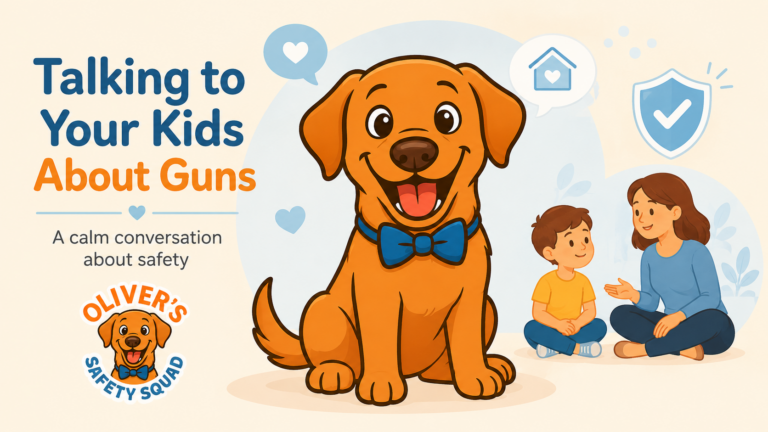
    A program we’re proud of: Oliver’s Safety Squad

    We can’t write a post about kids and safety without mentioning what we’ve built ourselves. Oliver’s Safety Squad is our children’s coloring book series, starring our shop dog Oliver and his lamb Clover. Each book covers age-appropriate safety topics in a calm, story-based format for kids ages 4-8 — outdoor hazards, holiday safety, the responsibility of caring for an animal, and the underlying habit of stop, think, check with a grown-up before doing something uncertain.

    The books aren’t a substitute for the conversation in this article. They’re a companion to it. Kids respond to characters and stories in a way that pure rule-recitation can’t reach, and Oliver has become a quiet bridge between parents and kids on topics that can otherwise feel hard to bring up.

    Pick one up next time you’re in the shop. They’re free, and we’d rather a copy be in your kid’s hands than on our shelf.

    If you need help having this conversation

    We’ve talked a lot of parents through this — whether they own firearms or not. If you’re not sure how to bring it up, what to say, what age to start, or what storage solution makes sense for your household, come by and ask. No purchase necessary. No pressure. We’re parents too. We get it.

  • Your First Range Trip

    Your First Range Trip: What to Bring, What to Expect, What to Wear

    g4gguns/
    May 12, 2026

    If you’re reading this because you’re about to go shooting for the first time, take a breath. You’re going to be fine. The shooting range is honestly one of the most rules-followed, safety-conscious environments most people will ever step into — there’s a reason everyone there is so quiet and focused. By the time you leave, you’ll know exactly why.

    But before you walk through that door, there’s a handful of things worth knowing — about what to bring, what to wear, what to expect, and yes, how to keep hot brass out of your shirt. (More on that.)

    This is the version of the conversation we’d have with you at the counter, written down so you can read it the night before.

    First, the basics: indoor vs. outdoor ranges

    These are two different experiences and it helps to know which one you’re walking into.

    Indoor ranges are enclosed, climate-controlled, and loud. Like, loud. The walls reflect every shot, including the ones from the people on either side of you. Hearing protection is non-negotiable here, and good hearing protection makes a noticeable difference. Indoor ranges usually have shooting lanes separated by partial dividers, paper targets on motorized retrievers, and a range officer somewhere nearby keeping an eye on things.

    Outdoor ranges are open-air, often quieter (because the sound dissipates instead of bouncing back at you), and usually have a wider variety of distances and target types — steel, paper, sometimes clay pigeons depending on the facility. Outdoor ranges feel more relaxed but the safety rules are exactly as serious. Weather is a factor: wind affects your shooting, sun affects your eyes, and rain affects your day.

    For a first range trip, indoor is often easier — the structure is more controlled, the staff is right there if you have questions, and the whole experience is predictable. But if you have access to a friendly outdoor range with someone showing you the ropes, that works beautifully too.

    What to bring

    Here’s the realistic checklist. You don’t need everything — most ranges rent or sell what you’re missing — but knowing what’s on the list takes the guesswork out.

    The essentials:

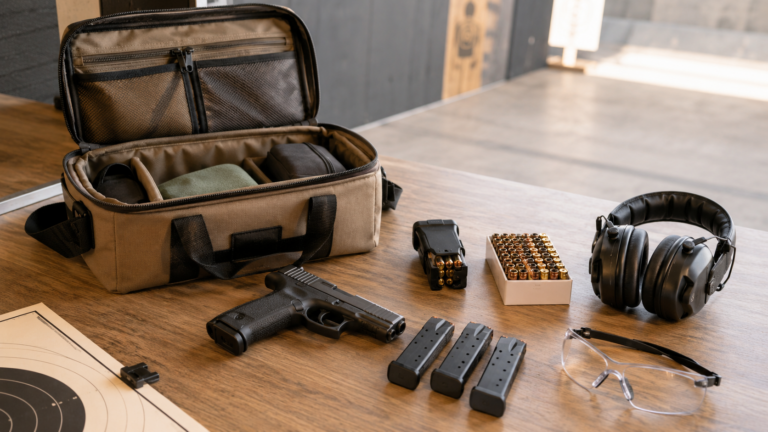
    • Your gun (in a case, unloaded, with the magazine out — more on this in the arrival section)
    • Ammunition — make sure it’s the correct caliber for your gun. If you’re not sure, the staff will check
    • Eye protection (safety glasses, ANSI Z87.1 rated — most ranges require this and rent them if you don’t have any)
    • Ear protection (foam plugs, earmuffs, or electronic muffs — we’ll explain the differences below)
    • Your driver’s license or ID

    Helpful but not required:

    • A range bag to carry the above (any sturdy bag works for your first trip)
    • Targets, if your range allows you to bring your own (most provide them)
    • A baseball cap (you’ll see why)
    • Water — shooting is more physically tiring than people expect

    On hearing protection specifically: foam plugs are cheap and effective, earmuffs are easy to put on and take off, and electronic muffs (around $50-150) are genuinely worth considering if you’re going to shoot more than once or twice. They block the gunshots but let you hear normal conversation, which means the range officer can talk to you without taking them off, and you can hear what your shooting buddy is saying without yelling. For an indoor range especially, doubling up with both plugs and muffs is a smart move.

    What to wear: the section nobody talks about

    Most “first range trip” guides skip clothing entirely. They shouldn’t. Here’s the truth: every gun, when fired, ejects the spent brass casing. That casing is hot — like, leave-a-mark-on-your-skin hot — and it goes wherever physics decides it goes, which is usually somewhere inconvenient.

    You’re going to want to dress with brass management in mind.

    A hat with a brim

    This is the single most important piece of clothing advice we can give you. Wear a baseball cap or a hat with a brim. The brim catches hot brass that would otherwise come back at your face — including, if you stand at the wrong angle to certain shooters, your forehead.

    Personal note from one of us: my husband has one particular firearm that, no matter where I stand behind him, somehow flings hot brass directly at my forehead. Every time. We’ve tested this. It defies all known laws of physics. The hat solves it. Always the hat.

    The brim also keeps brass out of your eyes — even with safety glasses on, a hot piece of brass landing on your eyelid is a memorable experience you don’t need to have.

    A high-necked or crew-neck shirt

    A V-neck, scoop neck, or low-cut top is an open invitation for hot brass to land directly on your sternum and stay there until you do an undignified shimmy in front of a bunch of strangers. Wear a crew neck, a turtleneck, a high-necked tank, or a button-up shirt buttoned to the second button from the top. This is not the trip for that cute V-neck.

    For women specifically: a high-cut sports bra under a crew-neck shirt is your friend. Even a single piece of brass making it past the collar can be genuinely painful, and trying to fish it out with a loaded gun in hand is a problem nobody wants. Block the entry point.

    Closed-toe shoes

    This one’s easier. Sneakers, boots, anything that fully covers your feet. No flip-flops, no sandals, no open-toe anything. Hot brass on bare toes is a quick way to end a range trip early. Most ranges actively require closed-toe shoes and will turn you away if you show up in flip-flops.

    Bonus: closed-toe shoes also protect your feet from the spent brass that accumulates on the floor. After an hour of shooting, the floor around the line can look like a copper carpet. You don’t want to be navigating that in sandals.

    What to actually wear, in summary

    For most people, the perfect range outfit is: a baseball cap, a crew-neck t-shirt or button-up, jeans or sturdy pants, and closed-toe shoes. That’s it. You’re not dressing up; you’re dressing for an environment that is going to throw small pieces of hot metal at you in unpredictable directions.

    What to expect when you arrive

    Walking into a range for the first time can feel intimidating. Here’s the script.

    At the front desk, you’ll usually sign in, present your ID, and either pay a lane fee or activate your membership. If it’s your first time at that specific range, you may be asked to watch a short safety video or read through their range rules. This is normal. Every range has slightly different rules, and they want to make sure you know theirs.

    Carry your gun in its case, unloaded, with the magazine separated. Don’t take it out of the case at the front desk. You’ll take it out at your shooting lane.

    The range officer is the person in charge of safety on the range floor. They will tell you when you can go hot (start shooting), when you need to go cold (stop shooting, usually so people can change their targets), and they’re available for questions. They are not scary. They are there to help. If you have any uncertainty about anything — how to load your magazine, where to point the gun, whether you’re holding it right — ask them. It’s literally their job, and they’d rather answer a question than fix a problem.

    At your lane, you’ll set up your gun, ammo, and targets. Targets typically clip to a holder that motorizes out to whatever distance you choose. For your first trip, start at 7 yards. Don’t try to be impressive — closer targets give you faster feedback and let you actually learn what you’re doing.

    The four universal safety rules apply at all times:

    1. Treat every gun as if it’s loaded
    2. Never point the gun at anything you’re not willing to destroy
    3. Keep your finger off the trigger until you’re ready to shoot
    4. Be sure of your target and what’s beyond it

    You’ll see signs everywhere reinforcing these. Read them. Follow them. Nobody at a range will give you a hard time for being extra cautious — but they will absolutely give you a hard time for being careless.

    What to expect physically

    A few things first-timers aren’t always prepared for:

    The noise is more than you think, even with hearing protection. You’ll feel each shot in your chest more than you’ll hear it. This is normal. Doubling up on hearing protection (plugs + muffs) helps a lot.

    Recoil is fine. Most modern handguns and rifles don’t kick nearly as hard as movies make them look. If you’re shooting something light like a 9mm or a .22, you’ll be surprised how manageable it is. Shotguns and larger rifles have more push, but a good stance handles it.

    Your hands will smell like gunpowder. This is just a fact. Wash thoroughly when you get home, and don’t eat or rub your eyes before you’ve washed up. Some ranges have wipes near the exit specifically for this — use them.

    You’ll get tired. Shooting requires concentration, and concentration burns calories. Forty-five minutes to an hour is a great length for a first trip. Don’t try to power through a marathon session — you’ll start making mistakes when you’re fatigued, and that’s exactly when accidents happen.

    What to do when you’re done

    Most ranges have a specific protocol for ending your session. Generally:

    1. Empty your gun — magazine out, chamber clear
    2. Case it before leaving the lane
    3. Sweep up your brass if the range expects you to (some keep it, some have you collect yours — ask)
    4. Wash your hands and face before you leave the building. Lead residue is real, and you don’t want to take it home

    If you used rental guns or rental gear, return everything before you head out. Most ranges have a tip jar somewhere — if your range officer was helpful, a few dollars is appreciated. Your gun will likely need a good cleaning after. Some ranges will do this for you for a fee, but doing it yourself can be… oddly zen.

    A few things you don’t have to worry about

    If you’re nervous, ignore the fancy stuff for now:

    • Tactical clothing (you don’t need any of it)
    • Custom ear protection (basic ear protection is fine to start)
    • Performance shooting accessories (not for trip one)
    • Looking like you know what you’re doing (literally nobody cares — most people are focused on their own targets)

    The shooting community is, almost without exception, friendly to new shooters. People remember being new. If you walk in clearly trying to do things right, people will go out of their way to help you.

    When in doubt, ask us first

    If you’re not sure what to bring, what kind of ammo to use, or even which range to start at, come by the shop and ask. We’ve sent a lot of first-timers out for their first trip and brought them back for their second. We’ll help you make sure you’ve got what you need, that your ammo matches your gun, and that you know what to expect when you walk in.

    Your first range trip is a milestone. You’ll remember it. The goal is to make sure what you remember is “that was actually really fun” — not “I had hot brass in my shirt for forty-five minutes.”

    We’ve got you. 🎯

0
    0
    Your Cart
    Your cart is emptyReturn to Shop