

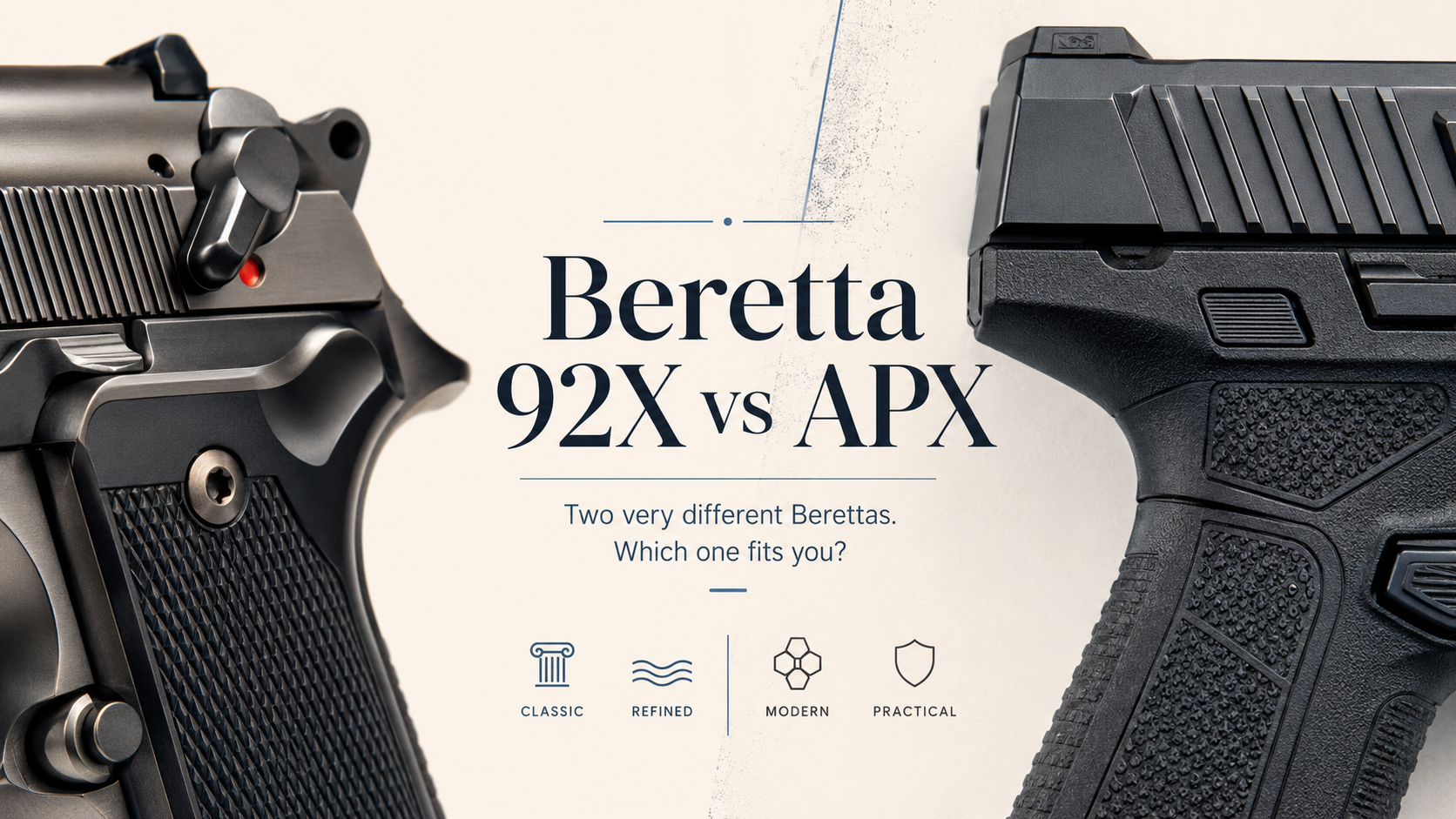
If you’ve narrowed your handgun search down to Beretta — first of all, good taste. Beretta has been making firearms for five hundred years, and the company’s craftsmanship and engineering are some of the best in the industry. But once you’re shopping Beretta, you almost immediately run into a fork in the road: the 92X vs APX A1.
Both are full-size 9mm handguns. Both are made by the same company. Both have devoted fans. And they could not be more different from each other.
This is the conversation we have at the counter when someone comes in asking which one to buy. Here’s the honest version, written down.
The short version
If you want the quickest possible answer:
- The 92X is for shooters who want a refined, hammer-fired, all-metal-frame 9mm with deep heritage, exceptional accuracy, and a shooting experience that feels like a piece of fine machinery. It’s the modern evolution of the gun that served as the U.S. military’s M9 for thirty-plus years. Heavier, more expensive, more romantic.
- The APX A1 is for shooters who want a modern, striker-fired, polymer-frame 9mm at a fighting price, with everything today’s market expects — optics-ready, modular grip, ambidextrous controls, light rail. Lighter, cheaper, more practical.
You’re not really comparing two of the same kind of thing. You’re comparing two answers to the question “what should a modern Beretta 9mm be?” — one that honors the past and one that engages with the present.
Now, the long version.
The 92X: The modern descendant of an icon
The 92-series is one of the most recognizable handgun platforms in the world. If you’ve watched a Hollywood action movie in the last forty years, you’ve seen one. The U.S. military adopted the 92FS as the M9 service pistol in 1985 and used it as their sidearm until 2017. It’s the gun that defined what a “service pistol” looked like for a generation.
The 92X is the current production refresh of that platform. Same fundamental design — short-recoil-operated, hammer-fired, single-action/double-action with an exposed barrel — but with modern updates: better ergonomics, improved trigger, beveled magazine well, updated controls, and a Vertec-style straight backstrap that fits a wider range of hands than the original 92FS curve.
What you’re getting:
- A full-size, full-metal 9mm with a steel slide and aluminum alloy frame (it’s heavy — about 33 ounces unloaded)
- DA/SA action: first trigger pull is long and heavy (double-action), subsequent shots are short and light (single-action) once the hammer is cocked
- Exposed barrel design — distinctive Beretta look, easy to inspect and maintain
- 17-round magazine capacity in standard configuration
- A long shooting history, deep aftermarket support, and parts available everywhere
What it feels like to shoot: Soft. The all-metal weight soaks up recoil in a way that polymer guns simply can’t, and the bore axis (where the barrel sits relative to your hand) keeps muzzle flip low. Most shooters describe the 92X as “easy to shoot well” — meaning your groups tighten up quickly because the gun isn’t fighting you.
The trade-off: it’s heavy. If you’re thinking concealed carry, the 92X is not your friend. This is a duty gun, a range gun, a home defense gun. Carrying 33 ounces of steel and aluminum on your hip all day is a commitment most people don’t make.
The APX A1: Beretta’s modern striker-fired entry
The original APX launched in 2017 as Beretta’s serious bid for the modern striker-fired market — going after the Glock, Sig P320, and Smith & Wesson M&P customers. The APX A1 is the refresh: same platform, but updated with optics-ready slide, improved trigger, redesigned grip texture, and lighter overall weight.
This is Beretta competing in the modern market on the modern market’s terms. Striker-fired. Polymer frame. Ambidextrous controls. Optics-ready. Light rail. Everything the contemporary 9mm shopper expects in 2026.
What you’re getting:
- A full-size, polymer-frame 9mm with a steel slide
- Striker-fired action: every trigger pull is consistent — no DA/SA transition to learn
- About 27 ounces unloaded — meaningfully lighter than the 92X
- 17-round magazine capacity in standard configuration
- Factory optics-ready with a multi-footprint plate system (fits most popular red dots without an adapter)
- Aggressive slide serrations front and rear, full-length accessory rail, ambidextrous slide stop and magazine release
- A significantly lower price point than the 92X — usually $200-300 cheaper
What it feels like to shoot: Modern, predictable, and practical. The trigger is consistent shot to shot, which makes the APX easier to learn than a DA/SA gun. The grip texture is aggressive in a good way — it stays put under recoil even with wet hands. It’s not as soft to shoot as the all-metal 92X, but it’s far from snappy. It’s a gun that gets out of the way and lets you focus on your shooting.
The APX A1 was designed for shooters who care less about heritage and more about how a gun performs when they’re actually using it — at the range, on duty, or in a defensive context.
Side-by-side at a glance
| Beretta 92X | Beretta APX A1 | |
|---|---|---|
| Action | Hammer-fired, DA/SA | Striker-fired |
| Frame | Aluminum alloy | Polymer |
| Weight (unloaded) | ~33 oz | ~27 oz |
| Capacity | 17+1 | 17+1 |
| Optics-ready | Specific variants only | Yes, factory standard |
| Light rail | Yes (Picatinny) | Yes (Picatinny) |
| Trigger | Long first pull, short follow-ups | Consistent every pull |
| Best use | Range, home defense, duty | Range, home defense, duty, some concealed carry |
| Price range | $700-900 | $400-550 |
| Heritage | Direct descendant of the M9 service pistol | Modern from the ground up |
The four big questions to ask yourself
This is what we walk through with people at the counter.
1. Do you want to learn a DA/SA trigger?
This is the single biggest functional difference between the two guns. The 92X has a long, heavy first trigger pull (double-action) — and then every shot after that is short and light (single-action) because the hammer is cocked from the cycling slide. The APX A1 has a consistent trigger every single shot.
A DA/SA trigger is not difficult, but it does require practice and an understanding that your first and second shots feel very different. Some shooters love this — the long first pull is a built-in safety feature, and the short follow-ups are buttery. Other shooters find it frustrating and prefer the predictability of striker-fired.
If you’re newer to handguns or just want one less variable to manage, striker-fired (APX A1) is the simpler learning curve.
If you’ve shot DA/SA guns before, or you’re interested in the safety advantages of a heavy first pull, the 92X rewards practice in a way the APX doesn’t.
2. How much weight are you willing to carry, hold, or store?
Weight changes everything about a handgun.
The 92X’s 33-ounce all-metal frame is gorgeous at the range — it soaks up recoil, balances well in the hand, and feels substantial. But it’s a lot of gun to hold up for a long shooting session, and it’s a serious commitment if you’re considering it for any kind of concealed carry. Most people who carry concealed don’t reach for a 92X.
The APX A1 at 27 ounces is still a full-size handgun — not pocket-pistol territory — but it’s noticeably easier to hold, handle, and (with the right setup) carry.
If your gun is going to live in a nightstand or a range bag, weight doesn’t matter much. The 92X wins on shooting feel.
If you might want to carry it occasionally or shoot it for long range sessions without fatigue, the APX A1 is easier to live with.
3. Do you want optics-ready out of the box?
Red dot sights are becoming standard on serious-use handguns, and an optics-ready slide is increasingly important for anyone thinking about adding one.
The APX A1 is optics-ready from the factory with a multi-footprint plate system that fits most popular red dot sights without needing an adapter. This is genuinely future-proof — whatever red dot you eventually want, the APX A1 is ready for it.
The 92X is optics-ready in specific variants only — there’s a 92X RDO model that comes optics-cut, but the standard 92X does not. If you want a red dot on a 92X, you’re either buying the RDO version or sending the slide off to be milled.
If a red dot is in your near future, the APX A1 is the more straightforward path.
4. What’s your budget?
Honest pricing reality at the counter:
- A 92X runs roughly $800 + depending on configuration.
- An APX A1 runs roughly $400-550 (The micro variant can hit below $300)
That’s a $200-300 gap, and what you’re paying for with the 92X is materials and heritage. The aluminum frame, the steel slide, the refined Italian manufacturing, the lineage of the M9 platform — those are real things, but they show up in the price tag.
The APX A1 is the better value gun by most objective measures. The 92X is the better experience gun for people who want to feel the difference.
Who buys which one
After thirteen years of selling Beretta handguns, here are the patterns we see.
People who buy the 92X:
- Shooters who served with an M9 in the military and want the modern civilian equivalent
- Beretta loyalists who appreciate the heritage and the all-metal feel
- Shooters who already own polymer striker-fired guns and want something different — a “shooter’s pistol”
- Home defense buyers who want the heft and want the long first pull as a layered safety feature
- Competition and target shooters who appreciate the accuracy potential and softer recoil
People who buy the APX A1:
- First-time handgun buyers who want a modern, practical, optics-ready gun at a reasonable price
- Shooters who came in looking at Glocks or Sigs and discovered the APX outperforms them in several categories at a lower price
- Buyers who want one full-size do-everything gun for range, home defense, and occasional carry
- Shooters who want to mount a red dot from day one without paying for slide milling
- Practical-minded buyers who don’t care about brand romance and just want the gun that works best for their use case
Our honest recommendation
If you want us to just tell you what to buy, here’s the honest version:
Get the APX A1 if this is your only handgun or your everyday-use handgun. It’s more versatile, more affordable, optics-ready out of the box, and easier to learn. For most shooters in 2026, it’s the practical right answer.
Get the 92X if you already have a practical handgun and you want something more. Something that connects you to a hundred years of firearm history. Something that feels like fine machinery when you pick it up. Something that rewards practice and patience. The 92X is the gun you want when you already know what you’re doing — or when you’re ready to grow into something with depth.
Both are excellent. Beretta doesn’t make a bad handgun. The question is what kind of relationship you want with the firearm you’re about to own.
Come handle them both
This is the part where we say what we always say: come into the shop and handle them. A blog post can tell you the specs, the action types, and the price difference. But the moment you pick up a 92X — feel the weight, the balance, the way it settles into your hand — and then pick up an APX A1 right after, you’ll know within thirty seconds which one is calling to you.
We’ve got both. Stop in. We’ll let you handle them, dry-fire them safely, talk through whichever questions come up, and help you figure out which Beretta is the right Beretta for you.
We promise: there are no wrong answers in this comparison. Just different ones.
Leave a Reply