

If you’re reading this because you’re about to go shooting for the first time, take a breath. You’re going to be fine. The shooting range is honestly one of the most rules-followed, safety-conscious environments most people will ever step into — there’s a reason everyone there is so quiet and focused. By the time you leave, you’ll know exactly why.
But before you walk through that door, there’s a handful of things worth knowing — about what to bring, what to wear, what to expect, and yes, how to keep hot brass out of your shirt. (More on that.)
This is the version of the conversation we’d have with you at the counter, written down so you can read it the night before.
First, the basics: indoor vs. outdoor ranges
These are two different experiences and it helps to know which one you’re walking into.
Indoor ranges are enclosed, climate-controlled, and loud. Like, loud. The walls reflect every shot, including the ones from the people on either side of you. Hearing protection is non-negotiable here, and good hearing protection makes a noticeable difference. Indoor ranges usually have shooting lanes separated by partial dividers, paper targets on motorized retrievers, and a range officer somewhere nearby keeping an eye on things.
Outdoor ranges are open-air, often quieter (because the sound dissipates instead of bouncing back at you), and usually have a wider variety of distances and target types — steel, paper, sometimes clay pigeons depending on the facility. Outdoor ranges feel more relaxed but the safety rules are exactly as serious. Weather is a factor: wind affects your shooting, sun affects your eyes, and rain affects your day.
For a first range trip, indoor is often easier — the structure is more controlled, the staff is right there if you have questions, and the whole experience is predictable. But if you have access to a friendly outdoor range with someone showing you the ropes, that works beautifully too.
What to bring
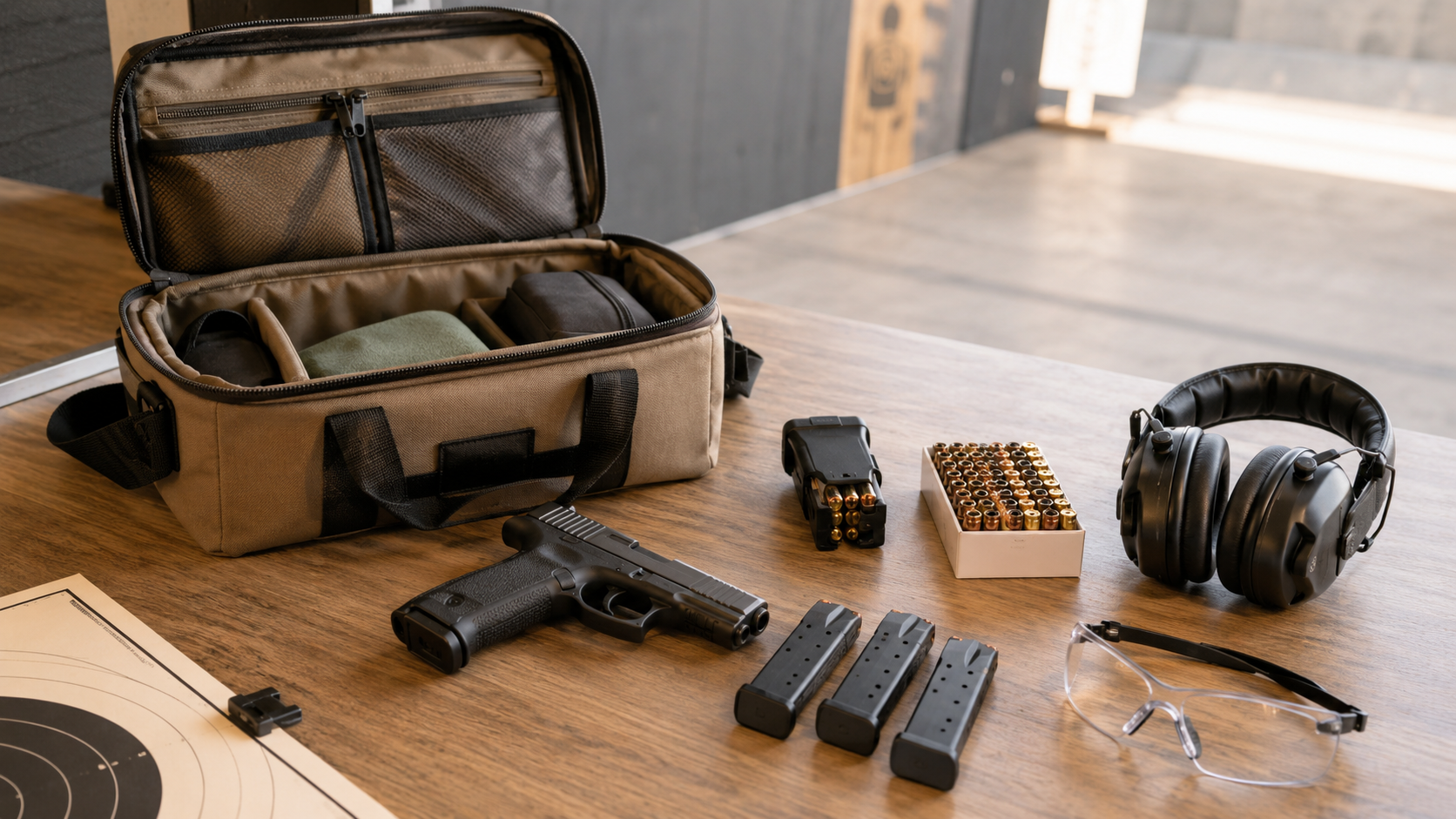
Here’s the realistic checklist. You don’t need everything — most ranges rent or sell what you’re missing — but knowing what’s on the list takes the guesswork out.
The essentials:
- Your gun (in a case, unloaded, with the magazine out — more on this in the arrival section)
- Ammunition — make sure it’s the correct caliber for your gun. If you’re not sure, the staff will check
- Eye protection (safety glasses, ANSI Z87.1 rated — most ranges require this and rent them if you don’t have any)
- Ear protection (foam plugs, earmuffs, or electronic muffs — we’ll explain the differences below)
- Your driver’s license or ID
Helpful but not required:
- A range bag to carry the above (any sturdy bag works for your first trip)
- Targets, if your range allows you to bring your own (most provide them)
- A baseball cap (you’ll see why)
- Water — shooting is more physically tiring than people expect
On hearing protection specifically: foam plugs are cheap and effective, earmuffs are easy to put on and take off, and electronic muffs (around $50-150) are genuinely worth considering if you’re going to shoot more than once or twice. They block the gunshots but let you hear normal conversation, which means the range officer can talk to you without taking them off, and you can hear what your shooting buddy is saying without yelling. For an indoor range especially, doubling up with both plugs and muffs is a smart move.
What to wear: the section nobody talks about
Most “first range trip” guides skip clothing entirely. They shouldn’t. Here’s the truth: every gun, when fired, ejects the spent brass casing. That casing is hot — like, leave-a-mark-on-your-skin hot — and it goes wherever physics decides it goes, which is usually somewhere inconvenient.
You’re going to want to dress with brass management in mind.
A hat with a brim
This is the single most important piece of clothing advice we can give you. Wear a baseball cap or a hat with a brim. The brim catches hot brass that would otherwise come back at your face — including, if you stand at the wrong angle to certain shooters, your forehead.
Personal note from one of us: my husband has one particular firearm that, no matter where I stand behind him, somehow flings hot brass directly at my forehead. Every time. We’ve tested this. It defies all known laws of physics. The hat solves it. Always the hat.
The brim also keeps brass out of your eyes — even with safety glasses on, a hot piece of brass landing on your eyelid is a memorable experience you don’t need to have.
A high-necked or crew-neck shirt
A V-neck, scoop neck, or low-cut top is an open invitation for hot brass to land directly on your sternum and stay there until you do an undignified shimmy in front of a bunch of strangers. Wear a crew neck, a turtleneck, a high-necked tank, or a button-up shirt buttoned to the second button from the top. This is not the trip for that cute V-neck.
For women specifically: a high-cut sports bra under a crew-neck shirt is your friend. Even a single piece of brass making it past the collar can be genuinely painful, and trying to fish it out with a loaded gun in hand is a problem nobody wants. Block the entry point.
Closed-toe shoes
This one’s easier. Sneakers, boots, anything that fully covers your feet. No flip-flops, no sandals, no open-toe anything. Hot brass on bare toes is a quick way to end a range trip early. Most ranges actively require closed-toe shoes and will turn you away if you show up in flip-flops.
Bonus: closed-toe shoes also protect your feet from the spent brass that accumulates on the floor. After an hour of shooting, the floor around the line can look like a copper carpet. You don’t want to be navigating that in sandals.
What to actually wear, in summary
For most people, the perfect range outfit is: a baseball cap, a crew-neck t-shirt or button-up, jeans or sturdy pants, and closed-toe shoes. That’s it. You’re not dressing up; you’re dressing for an environment that is going to throw small pieces of hot metal at you in unpredictable directions.
What to expect when you arrive
Walking into a range for the first time can feel intimidating. Here’s the script.
At the front desk, you’ll usually sign in, present your ID, and either pay a lane fee or activate your membership. If it’s your first time at that specific range, you may be asked to watch a short safety video or read through their range rules. This is normal. Every range has slightly different rules, and they want to make sure you know theirs.
Carry your gun in its case, unloaded, with the magazine separated. Don’t take it out of the case at the front desk. You’ll take it out at your shooting lane.
The range officer is the person in charge of safety on the range floor. They will tell you when you can go hot (start shooting), when you need to go cold (stop shooting, usually so people can change their targets), and they’re available for questions. They are not scary. They are there to help. If you have any uncertainty about anything — how to load your magazine, where to point the gun, whether you’re holding it right — ask them. It’s literally their job, and they’d rather answer a question than fix a problem.
At your lane, you’ll set up your gun, ammo, and targets. Targets typically clip to a holder that motorizes out to whatever distance you choose. For your first trip, start at 7 yards. Don’t try to be impressive — closer targets give you faster feedback and let you actually learn what you’re doing.
The four universal safety rules apply at all times:
- Treat every gun as if it’s loaded
- Never point the gun at anything you’re not willing to destroy
- Keep your finger off the trigger until you’re ready to shoot
- Be sure of your target and what’s beyond it
You’ll see signs everywhere reinforcing these. Read them. Follow them. Nobody at a range will give you a hard time for being extra cautious — but they will absolutely give you a hard time for being careless.
What to expect physically
A few things first-timers aren’t always prepared for:
The noise is more than you think, even with hearing protection. You’ll feel each shot in your chest more than you’ll hear it. This is normal. Doubling up on hearing protection (plugs + muffs) helps a lot.
Recoil is fine. Most modern handguns and rifles don’t kick nearly as hard as movies make them look. If you’re shooting something light like a 9mm or a .22, you’ll be surprised how manageable it is. Shotguns and larger rifles have more push, but a good stance handles it.
Your hands will smell like gunpowder. This is just a fact. Wash thoroughly when you get home, and don’t eat or rub your eyes before you’ve washed up. Some ranges have wipes near the exit specifically for this — use them.
You’ll get tired. Shooting requires concentration, and concentration burns calories. Forty-five minutes to an hour is a great length for a first trip. Don’t try to power through a marathon session — you’ll start making mistakes when you’re fatigued, and that’s exactly when accidents happen.
What to do when you’re done
Most ranges have a specific protocol for ending your session. Generally:
- Empty your gun — magazine out, chamber clear
- Case it before leaving the lane
- Sweep up your brass if the range expects you to (some keep it, some have you collect yours — ask)
- Wash your hands and face before you leave the building. Lead residue is real, and you don’t want to take it home
If you used rental guns or rental gear, return everything before you head out. Most ranges have a tip jar somewhere — if your range officer was helpful, a few dollars is appreciated. Your gun will likely need a good cleaning after. Some ranges will do this for you for a fee, but doing it yourself can be… oddly zen.
A few things you don’t have to worry about
If you’re nervous, ignore the fancy stuff for now:
- Tactical clothing (you don’t need any of it)
- Custom ear protection (basic ear protection is fine to start)
- Performance shooting accessories (not for trip one)
- Looking like you know what you’re doing (literally nobody cares — most people are focused on their own targets)
The shooting community is, almost without exception, friendly to new shooters. People remember being new. If you walk in clearly trying to do things right, people will go out of their way to help you.
When in doubt, ask us first
If you’re not sure what to bring, what kind of ammo to use, or even which range to start at, come by the shop and ask. We’ve sent a lot of first-timers out for their first trip and brought them back for their second. We’ll help you make sure you’ve got what you need, that your ammo matches your gun, and that you know what to expect when you walk in.
Your first range trip is a milestone. You’ll remember it. The goal is to make sure what you remember is “that was actually really fun” — not “I had hot brass in my shirt for forty-five minutes.”
We’ve got you. 🎯
Leave a Reply