Category: Blog

  • AR-15 Builder Beta

    Introducing the Good 4 Guns AR-15 Builder- Come Beta Test It

    g4gguns/
    June 1, 2026

    A new way to spec your build — now in beta, and we’d like your help testing it.

    Anyone who’s tried to spec out an AR-15 build from scratch knows the loop. You pick a caliber. You pick an upper. You go down the rabbit hole on barrels and realize your gas system length doesn’t match what you wanted. You back up. You change the upper. Now your handguard doesn’t fit. You back up again. Two hours in, you have fourteen browser tabs open and you’re looking at trigger options that don’t actually work with the lower you started with.

    We’ve watched customers do this at the counter. We’ve done it ourselves. It’s not that AR builds are complicated — they’re extremely well-documented and the modularity is the whole point of the platform. The problem is that compatibility and use-case fit aren’t always obvious until you’ve already added six things to a cart that don’t belong together.

    So we built a tool to fix it. It’s called the Good 4 Guns AR-15 Builder, it’s live on our site as of today, and we’d genuinely like you to be one of the first people to try it. Fair warning up front: it’s a beta. More on what that means in a minute.

    What the Builder actually does

    The Builder is a guided spec-out tool that takes you from “I want to build an AR” to a complete, FFL-routed cart in about ten minutes. It’s designed for people who know what an AR is and have probably handled a few, but who’d rather not spend an evening cross-checking gas block diameters against barrel profiles.

    The flow is three steps, in this order:

    Step 1. Tell us about your build. You answer three questions: caliber preference, budget, and primary use. The use options include range, hunting, duty, plinking, and home defense — deliberately chosen because the right parts for a 600-yard precision build are not the right parts for a home defense carbine, and we’d rather ask than guess.

    Step 2. Pick your parts. The Builder recommends specific parts in each category based on what you told it in Step 1. Everything is here — upper, lower, barrel, BCG, trigger, handguard, stock, grip, charging handle, optic, sling, magazines, the works. You can swap any individual piece for something else from our inventory.

    Step 3. Add to cart. Everything in your build lands in your cart in one click. From there, checkout works the way checkout always works on our site — you pick an FFL off our list for the serialized parts, and we handle the routing on our end.

    That’s the whole tool. There’s no signup wall, no save-your-build account requirement, no upsell. You can try it right now without giving us anything.

    Try the AR-15 Builder → g4gguns.com/ar15-builder

    Why we built it

    Honest answer: we built it because the alternative — picking parts a la carte across forty-some product categories — is a worse experience than it needs to be, and because most of the existing build tools out there are owned by larger retailers who want to sell you their house brand of everything. We wanted a tool that recommends genuinely good parts at a given budget without funneling you toward whatever has the highest margin.

    The recommendation logic is built around how we’d talk you through a build at the counter. If you tell us you want a 5.56 range gun on a budget, we’re not going to recommend the same barrel we’d put on a duty build. If you say home defense, the optic, sling, and barrel length recommendations all shift accordingly. The tool doesn’t replace the conversation we’d have in person — you can still come in and ask questions, and you should — but it gets you 90% of the way there before you ever walk in.

    The other answer is that AR builds are one of the most common counter questions we get from intermediate shooters. People who’ve owned a complete AR, learned what they like and don’t like, and now want to build something specific to them. That’s a customer who already knows what they’re doing — they just need a smarter starting point than a search bar.

    About the beta

    This is the part where we’re going to be honest with you, because we’d rather you go in with the right expectations than be surprised.

    The Builder is live, it works, and we’re proud of it. We’re also calling it a beta on purpose. The tool went through our internal testing, but there’s a real difference between “it works when we use it” and “it works for every possible combination a real customer will try.” The only way to find that second category of bugs is to put it in real hands and see what happens.

    So if you build something with it this week and you find:

    • A caliber recommendation that doesn’t feel right for the use case you selected
    • A part recommendation that conflicts with another part the tool already added
    • Something obvious that you wanted to spec but couldn’t find a category for
    • Anything broken, weird, slow, confusing, or just off

    — we want to know about it. That’s the whole point of a beta. We’re especially interested in whether the caliber recommendations line up with what experienced builders would actually pick. If you go through the tool, get to the end, and think “I would have picked something completely different here,” that’s exactly the feedback that makes the next version better.

    How to send feedback If you hit a bug or have a suggestion, the fastest paths are emailing us, or telling us in person next time you’re in. We’re tracking everything that comes in and using it to refine the tool. No feedback is too small — if something felt off, we want to hear about it.

    A few honest expectations

    Because we said we’d be honest about what this is, here are the things worth knowing before you start:

    Inventory drives recommendations. The Builder recommends from what we actually have. If a part you’d normally pick isn’t in stock with us right now, you won’t see it. That’s a feature, not a bug — we’d rather show you things you can actually buy today than tease you with things on backorder.

    Defaults are good, but they’re defaults. If you know exactly what you want in a category, swap the recommendation. The tool is a starting point, not a verdict. The whole point of the AR platform is that you get to choose.

    Serialized parts go through an FFL. Stripped lowers and any other serialized components in your build will route to whatever FFL you select at checkout. Same process as any other firearm purchase. If you’re using Good 4 Guns as your FFL, you can ship all the parts for your build to pick up here for free.

    It’s going to keep getting better. We’re going to keep refining the tool based on what we learn from this beta. Caliber tuning, part coverage, the question flow at the start — all of it is on the table. The version live today is the floor, not the ceiling.

    Who this is for (and who it isn’t)

    The Builder is best suited for shooters who:

    • Know what an AR-15 is and have probably shot one
    • Want to spec a build for a specific use rather than buy a complete off the shelf
    • Have a clear budget and want recommendations within it
    • Don’t want to spend three weeks researching gas block diameters and buffer weights

    It’s probably not the right tool for:

    • Brand-new shooters buying their first rifle (we’d steer you to a complete firearm first — see our AR-15 buyer’s guide for the reasoning)
    • Custom precision builders working on something exotic where you already know every part you want — the regular product catalog is faster for you

    If you’re somewhere in the middle and not sure, just try it. The tool doesn’t commit you to anything until you check out, and walking through it is informative even if you don’t buy anything at the end.

    Go try it

    The Builder is live now at g4gguns.com/ar15-builder. It takes about ten minutes to get from the first question to a complete cart. If you build something you like, great — check out and we’ll get it routed to your FFL. If you build something that surfaces a bug or a weird recommendation, even better — tell us, and you’ll have helped shape the version everyone else uses later.

    We’re excited about this one. Genuine thanks in advance to anyone who takes it for a spin in the next few weeks. Beta testing isn’t glamorous work, but it’s how anything actually good gets made.

    See you in the Builder.

    Found a bug? Have feedback? Email us, or stop in. We’re tracking everything.

    Good 4 Guns · Van Alstyne, TX · g4gguns.com

  • Concealed Carry Summer Heat

    Summer Concealed Carry in Texas: How to Carry When It’s 104 Degrees

    g4gguns/
    May 26, 2026

    There’s a stretch of the year in North Texas where the heat stops being weather and starts being a personality. You walk to your truck and the steering wheel tries to brand you. The dog refuses to go outside until sundown. And if you carry concealed, the season brings a very specific problem that nobody warned you about when you bought your first gun: how do you actually hide a firearm when you’re wearing shorts and a t-shirt?

    It’s one of the most common questions we get across the counter once summer hits. Folks who carried comfortably all winter under a jacket suddenly feel like the whole thing is impossible in July. The good news is that it isn’t. People carry concealed in brutal heat all over the South, every single day, and most of them figured it out through trial and error and a little advice from someone who’d been there.

    This is that advice. No lectures, no “well actually,” just the practical stuff that actually helps when the temperature has a comma in it.

    A quick note before we start This guide is about comfort and practicality, not the law. If you’re still sorting out whether you need a License to Carry, what the signage rules are, or where you can and can’t carry in Texas, start with our full Texas concealed carry guide first — then come back here for the summer-specific stuff.

    Why Summer Is Genuinely Harder (You’re Not Imagining It)

    Winter carry is easy mode, and most people don’t realize it until it’s gone. A jacket, a flannel, a hoodie — any of them will swallow a full-size handgun and never tell a soul. You get spoiled. Then summer arrives and takes away your cover garment, your waistband real estate, and your patience all at once.

    There are three things working against you in the heat, and naming them makes them a lot easier to solve:

    • Less fabric. Thin cotton and athletic wear print far more easily than denim and wool. The outline of the gun shows through.
    • More movement. You’re more active in summer — reaching, bending, getting in and out of a hot vehicle — and lighter clothing shifts more, which means your setup has to actually stay put.
    • Sweat. Nobody likes to talk about it, but a steel slide against bare skin all day is a comfort and corrosion problem. It’s solvable, but you have to plan for it.

    Every recommendation in this guide is really just a way of answering one of those three problems. Once you see it that way, the gear conversation gets a lot less overwhelming.

    Strategy One: Carry a Smaller Gun (At Least Sometimes)

    This is the simplest lever you can pull, and it’s the one people resist the most. If you carry a full-size duty pistol all winter, summer is a reasonable time to consider a smaller everyday option. A compact or micro-compact prints less, weighs less, and forgives lighter clothing in a way a larger gun simply won’t.

    This isn’t about “downgrading.” Plenty of people run a two-gun rotation — a larger pistol for cooler months or open-cover days, and a slimmer one for the dead of summer. The micro-compact category has gotten genuinely good over the last few years, and a gun you’ll actually carry beats a bigger gun that lives in the safe from June to September because it’s a pain to conceal.

    If you’re thinking about adding a summer carry gun to the rotation, our honest comparison of the most popular concealed carry pistols is a good place to start — it’s written by people who sell all of them and don’t have a dog in the fight.

    The honest version We’re not going to tell you the gun you already own is wrong. If it conceals fine for you in summer, keep carrying it. A second smaller gun is an option, not a requirement — and it’s a real cost. Don’t let anyone shame you into a purchase you don’t need.

    Strategy Two: Rethink Where You Carry It

    Carry position matters more in summer than any other time of year, because position is what decides whether a thin shirt gives you away. Here are the realistic options and the honest tradeoffs of each — not a sales pitch, just what tends to work in the heat.

    PositionWhy it works in summerThe tradeoff
    Appendix (AIWB)Conceals very well under an untucked t-shirt; the gun sits flat against the body and is easy to cover.Takes practice to find a comfortable, safe setup. Not everyone’s body type loves it. Worth trying before committing.
    Strong-side IWBThe classic, most forgiving for most people. Hides well under an untucked shirt at the 3–4 o’clock position.Can print when you bend or reach. A slightly looser shirt solves most of it.
    Pocket carryGenuinely useful for the smallest guns when you’re in shorts or athletic wear with no belt.Only works with a true pocket-size gun and a dedicated pocket holster. Slower to access.
    Belly band / waistband wrapCarries without a belt — perfect for gym shorts, athletic pants, and “I’m not wearing a real waistband today” situations.Less stable than a rigid holster and can get warm. A good one is worth the money; a cheap one isn’t.

    A note on holsters: Good 4 Guns doesn’t sell holsters, so we’ve got no reason to push you toward any particular brand. What we’ll tell you is the same thing we tell people at the counter — a quality holster that fully covers the trigger guard and holds the gun securely is one of the most important purchases you’ll make, and it’s not the place to save twenty dollars. Whatever position you choose, get a holster built for your specific gun.

    Strategy Three: Dress Around the Gun

    You don’t have to dress like you’re going on a cartel raid to conceal in summer. Small, normal wardrobe choices do almost all of the work, and none of them look tactical:

    • Pick prints and patterns. A patterned shirt breaks up the outline of a gun far better than a solid color. A plain white tee is the hardest thing to conceal under; a patterned camp shirt is one of the easiest.
    • Go one size looser on top. Not baggy — just not skin-tight. A shirt that skims the body instead of clinging to it hides a waistband gun without looking like you’re hiding anything. And to be honest… it allows for better air flow in the heat.
    • SLIGHTLY darker over light. Darker shirts show printing and sweat less than light ones. Be careful with this one though, because they also absorb heat faster.
    • The untucked camp shirt is your best friend. Short-sleeve, slightly structured, worn open over a tee or on its own — it’s breathable, looks completely normal in Texas summer, and conceals a waistband gun beautifully.

    Strategy Four: Deal With the Sweat Honestly

    This is the part most guides skip, and it’s the part that actually drives people to stop carrying in summer. Here’s the straight talk.

    A handgun riding against sweaty skin all day will rust if you ignore it. It’s not dramatic and it’s not instant, but it’s real. The fix is simple: wipe the gun down at the end of the day, and keep up with light maintenance through the summer months. If it’s been a hot, sweaty week, give it a quick clean and a wipe of oil — it takes five minutes.

    If you want a refresher on doing it right, our handgun cleaning walkthrough covers it step by step. For summer specifically, the move is more frequent light maintenance rather than one big cleaning — a quick wipe-down beats letting sweat sit. (One of us has a regular carry piece that is copper plated- guess which one- and it will literally form salt crystals if not cared for properly in the summer.)

    On the comfort side: a holster with a sweat guard or backer keeps the slide off your skin, which solves most of the discomfort and a good chunk of the corrosion problem at the same time. An undershirt does the same job in a pinch. Stainless and modern coated finishes handle moisture better than older blued guns, but none of them are immune — so just stay on top of it.

    The five-minute summer habit End of the day, gun comes off: a quick wipe-down with a clean cloth, a thin pass of oil on the slide, done. Do that consistently and summer carry never becomes a corrosion problem. Skip it for three sweaty months and you’ll see the difference.

    A Few Real-World Situations

    The pool, the lake, the river. Swimming and carrying don’t mix, so plan for storage. A locked container in the vehicle is far better than leaving a gun loose in a glovebox or, worse, in a bag on a towel. Think about this before you go, not in the parking lot.

    The hot car. A closed Texas vehicle in July is an oven, and that’s hard on ammunition and optics over time. Don’t make your car your permanent gun storage. If you have to leave it, leave it secured and don’t make a habit of it.

    Outdoor work and yard days. This is where a belly band or pocket setup earns its keep — you can carry without a belt while you’re sweating through chores, and it stays put while you move. Dog them all you want- but the belly bags are back for men and women both- let fashion work for you here and find a good one for moments like this.

    Cookouts and gatherings. Lighter, smaller, well-concealed is the whole game here. Nobody at the barbecue needs to know, and with a patterned shirt and a compact gun, nobody will.

    The Bottom Line

    Summer carry in Texas isn’t about white-knuckling through the heat or buying a closet full of tactical gear. It’s about making a few small adjustments — maybe a slimmer gun, definitely a smart carry position, a patterned shirt, and a five-minute end-of-day habit. Do those things and carrying in 104-degree weather stops being a problem you dread and goes back to being something you just do.

    And if you’re standing in your closet in June feeling like none of this is working, that’s exactly the kind of thing we’re here for. Come see us in Van Alstyne, or send us an email. We’ve all solved this for ourselves, and we’re happy to walk you through what worked — no pressure, no judgment, no upsell you didn’t ask for.

    Got a summer carry question we didn’t cover? Stop by the shop — we’d genuinely rather you ask than guess.

    Good 4 Guns · Van Alstyne, TX · g4gusa.com

  • Price match

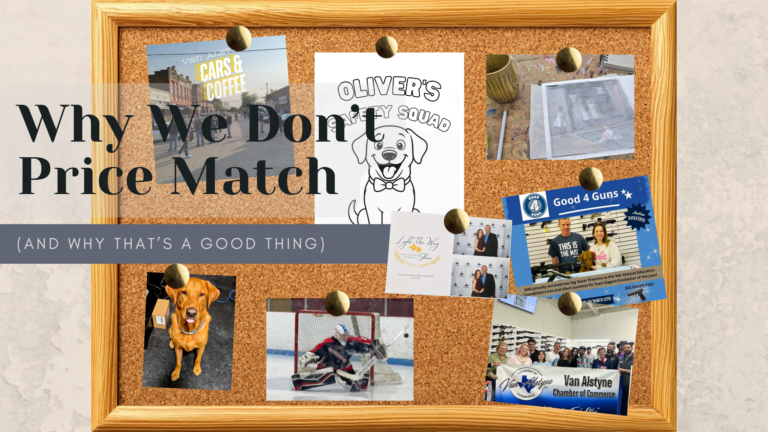
    Why We Don’t Price Match (And Why That’s A Good Thing)

    g4gguns/
    May 21, 2026

    We’re going to have an honest conversation about something most gun shops won’t talk about directly: we don’t price match. We never have, and we never will. And if you’ve ever asked us about it and gotten a quick “sorry, we don’t do that,” this is the longer answer we wish we had time to give you over email.

    Because the truth is, this isn’t a policy designed to squeeze more money out of you. It’s a policy designed to make sure the shop you walked into is still here next year, and the year after that, with the same staff, the same prices, and the same kind of help you came in expecting.

    Here’s the whole conversation.

    First, the honest version of what price matching actually is

    Price matching, in retail, is when a store agrees to lower their price on a specific item to match a lower price you found somewhere else. On its face, it sounds great for the customer — you get the better price and the local store.

    But here’s what’s actually happening behind the scenes:

    When you ask a gun shop to match an online price you found at a giant warehouse retailer or a third-party listing site, you’re asking them to operate on the same margins as a business with no storefront, no staff to pay, no transfer service, no support, no community presence, and no actual relationship with you- or worst case scenario, one actively going under.

    The shop has two choices when you ask. They can say yes and lose money on the sale — which means they have to make it up somewhere else, either by cutting staff hours, reducing inventory, or quietly raising prices on the items you’re not checking. Or they can say no and risk losing the sale entirely.

    Some shops, faced with that choice, say yes anyway and figure it out. That’s how a lot of small gun shops slowly die. They eat the margin to keep the customer, the margin disappears, and eventually so does the shop.

    We made a different choice — and we want to be transparent about it.

    What we chose instead

    We chose to set our prices honestly, transparently, and competitively from day one — and then hold them.

    That means:

    • Our shelf price is our real price. We don’t inflate sticker prices so we can pretend to negotiate. The number on the tag is the number we sell at. Some of that is because we hate to dicker (like.. really hate it), and some if it is because we don’t think anyone deserves to pay more just because they don’t ask.
    • We price competitively against other brick-and-mortar shops in our region, not against warehouse-scale online sellers. Those are two different markets and pretending they’re the same hurts everybody.
    • We don’t run “limited time” or “only today” pressure pricing. What we charge today on an item is what we’ll charge tomorrow. You don’t have to worry about missing a deal. We mark items on sale if we paid less for that item. If we have to pay more the next time we get the same item, the new price reflects that.
    • We don’t quietly raise prices on the items people don’t comparison-shop to make up for the ones they do. That’s a common retail trick and we don’t play it.

    The trade-off is that yes, you can sometimes find a lower sticker price somewhere else — usually online, usually from a warehouse-scale retailer, sometimes from someone who is already going out of business. Sometimes just from a store that bought 10x more of that thing than we did and got a better price. It happens.

    What you’re trading for that lower sticker price is everything else that comes with buying from a local shop.

    What you actually get when you buy from us

    This is the part of the conversation most price match policies skip over. Because if all you’re comparing is a number on a sticker, sure — the warehouse sometimes wins on the number. But that’s not all you’re buying.

    Here’s what’s actually included with every purchase at Good 4 Guns:

    Real, no-pressure help from people who shoot. Every member of our team can answer your questions, recommend the right gun for your hand and use case, and tell you honestly when something isn’t right for you — even when that means a smaller sale. We’ll remember your names, hand your kids free coloring books, and Oliver will likely even let you (demand that you) scratch his fuzzy little noggin.

    Hands-on time with the actual firearm before you buy it. You can hold it, dry-fire it (safely), feel the trigger, check the weight, see how it sits in your hand. The number one cause of buyer’s remorse on a gun purchase is buying something based on specs alone and discovering it doesn’t fit you. We solve that for free, every time. We’ll ask you questions that steer you in the right direction and not just leave you to figure it out for yourself.

    A transfer service that actually wants your business. If you ever do buy something elsewhere and have it shipped to us for transfer, we handle the paperwork, the background check, the inspection, and the conversation about whether what you bought is actually the right thing. We do this even though it’s not where our margin comes from — because it’s part of being a good steward of this business to our community. We want you here, please send us your transfers- we don’t mind.

    Post-sale support. If your gun has an issue, we help you navigate the manufacturer’s warranty process. You’re never alone with a problem (caveat here- there are real restrictions on what SHAPE that help can take, but we do our best with the restrictions at hand.)

    Community and continuity. When you buy from us, you become part of a network of customers who’ve been shopping with us for years — many for over a decade. Layaway, special orders, accessory recommendations, training referrals, the “hey, your gun’s ready to pick up” text — those things only exist because we’re a shop that worked hard to build real relationships. We support your kid’s sports teams, donate to community needs that matter to us all, show up to the clay shoots with fun new toys, and are there to cheer on the other businesses that make Van Alstyne a place we all love.

    A team that’s still here next year. Our staff isn’t gig workers cycling through. They’re people who know our customers by name. That continuity only exists because the shop is financially healthy enough to keep them. Price-matching every online warehouse erodes that until the shop collapses, the staff scatters, and the next time you need help, the place that knew you doesn’t exist anymore.

    The race-to-the-bottom problem

    Here’s the bigger picture, in case you want it.

    The firearms industry, like a lot of retail, is in a race to the bottom on sticker price. Warehouse-scale sellers and aggregator websites operate on margins that brick-and-mortar shops simply cannot match — and they don’t try to. They sell strictly on volume; we sell relationships, expertise, and trust. Those are different businesses.

    When customers expect every shop to match warehouse-scale pricing, what actually happens isn’t that customers get cheaper guns. What happens is that local shops disappear one by one, until the only options left are big-box warehouse retailers and online aggregators — and the prices at those places, once the competition is gone, do not stay low. They go up. And there’s nobody left to walk into.

    We’re not trying to be dramatic about this. We’re just telling you what the math is. A community without local gun shops is a community where new buyers have nowhere to learn safely and where buyer’s remorse becomes the norm because nobody handled the gun before they bought it.

    We’d rather charge a fair, honest price and still be here in ten years.

    What we’ll always do for you

    While we don’t price match, here’s what we will do, every single time:

    • Tell you the truth about price. If we know you can find a specific item cheaper somewhere else and the experience there will be fine, we’ll tell you. We’d rather you trust us than feel cornered.
    • Tell you when our price is actually a great deal compared to the market. Most of the time we beat online retailers on specific items because of our buying relationships. We’ll let you know when that’s true.
    • Honor all of our online sales in-store. We also offer cash discounts and have an extensive curation of heavily discounted items for our First Responders online. Check it out.
    • Help you find what’s right for your budget. If something on our shelf is outside your budget, we’ll walk you through alternatives — different models, different timing (sezzle, layaway). We have a layaway program specifically because we believe people should be able to make these purchases without financial stress.
    • Make sure you leave happy with what you bought. None of our employees work on commission. They don’t benefit from selling you something that costs more, they are motivated to make sure you have what works for you- not what works for us.

    And if you do find it cheaper somewhere else?

    We will be the first to tell you: it’s okay to buy it there. Genuinely.

    If a specific item is dramatically cheaper somewhere else, and you’ve evaluated the seller, you trust the source, and you’re confident the product is what they say it is — go ahead. We’re not going to be hurt that you went somewhere else for one purchase. We’d rather you make the choice that works for your wallet than feel pressured to pay more because you walked in our door first. We’re always happy to do your transfers for one of the lowest rates in the metroplex.

    And when you need help — when the gun arrives and you’re not sure if it’s the right one, when you want to talk through your next purchase — we’ll still be here. We’ll still help you. That’s the relationship.

    We don’t believe in earning customers by trapping them. We believe in earning customers by being worth coming back to.

    The bottom line

    We don’t price match because price-matching is the policy of a shop that’s competing on price alone — and we’re not. We’re competing on experience, expertise, integrity, relationships, and the kind of long-term trust that only exists when a shop holds its values steady year after year.

    Our prices are fair. Our staff is real. Our help is genuine. Our shop will still be here when you walk in next month, next year, and five years from now.

    That’s the trade. We think it’s a good one. And we hope, after reading this, you do too.

    One last thing.

    Now that we’ve spent fifteen minutes explaining why we don’t price match — we should probably mention that most of the time, we’re already the best price you’re going to find. We just are. We work hard at it. We’re approaching this article knowing we’re the shop most of the big-box guys get asked to price match against.

    They won’t either, by the way.

    And honestly? We get it. If we were on your side of the counter and we’d just learned that the same Glock 43X is $80 cheaper at the friendly local shop than at the big-box place we’ve got points at, we’d be doing the math too. The whole reason this article exists is that the math behind that price difference is real — different overhead, different scale, different cost to the store. It’s rarely a matter of “what do we think we can charge for this?”

    We keep our costs low where we can so our prices stay low too. If you’ve ever been in the shop, you’ve probably noticed we’re not exactly funding a lavish CEO lifestyle around here. Our cars are old. We fix things ourselves. We pay ourselves modestly — enough to care about the job, not enough to forget who pays the bills. We’re here to be here — a real part of the community, not a numbers game on the way to somebody’s yacht.

    Transparency is part of that. So is keeping prices honest. The two go together.

    Come see us

    If you’ve never been to the shop, come by. Bring your questions. Bring your comparison printouts if you’ve been doing your homework. We’ll talk you through whatever you’re looking at — honestly, without pressure, and without trying to convince you of anything that isn’t true.

    Buying a firearm should be one of the most informed, calm, well-supported purchases you ever make. We’re here to make sure it is.

0
    0
    Your Cart
    Your cart is emptyReturn to Shop