Category: Buyer Guides

  • Gifts for Gun Owners Good 4 Guns

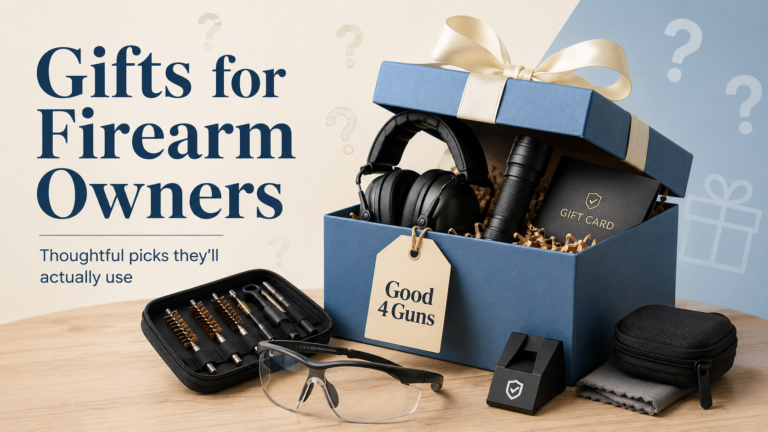
    Great Gifts for Someone Who Just Got Their First Gun

    g4gguns/
    May 19, 2026

    So someone you love just got their first gun, and now you’re sitting at your computer trying to figure out what to get them for their birthday, their anniversary, Father’s Day, Christmas, or just because. Maybe you don’t know much about firearms. Maybe you’re not sure where to start. You don’t want to get them something dumb, and you really don’t want to get them something dangerous.

    You’re in the right place. We help people pick out gifts for first-time gun owners all the time — and we’ve watched what works, what gets used, and what ends up in the bottom of a drawer.

    Here’s the honest, curated, no-nonsense version of the list.

    First, a few quick rules

    Before we get into specifics, two things to know:

    You don’t have to know what gun they have. Almost everything on this list is gun-agnostic — meaning it works for their first handgun, their first shotgun, or whatever they ended up with. You don’t need to know calibers or models. You just need to know they got into shooting.

    This guide assumes they’ve already got their gun. This is about what they need next — the gear, the gifts, the things that make their new hobby easier, safer, and more fun. The things they don’t know they need yet, or haven’t gotten around to buying for themselves.

    Now, the list.

    Under $25: The “Stocking Stuffer” Tier

    These are the small, useful, “oh, I’m glad I have this” gifts. Perfect on their own for a birthday card add-on, or grouped together to build a bigger gift basket.

    Quality eye protection. Every shooter needs safety glasses, and a lot of new shooters are still using whatever the range had to rent them on their first trip. A pair of comfortable, ANSI Z87.1-rated safety glasses is something they’ll use every single time they shoot. Pick a style that’s not bulky — most people prefer something they don’t feel ridiculous wearing.

    Foam ear plugs in bulk. Sounds boring. Isn’t. Quality foam plugs are the unsung hero of every range trip, and most people don’t keep enough of them on hand. A bulk pack of NRR 32+ plugs goes a long way. Most people end up using them for all kinds of things outside the range and will quietly think to themselves “I’m so glad so and so bought me these. What a rockstar.”

    A range bag patch or sticker. Personalization is underrated. A patch with their state, their unit, their favorite firearm manufacturer, their dog — something that turns their generic range bag into theirs. (We’ve got some good ones at the shop.)

    Under $50: The “Actually Useful” Tier

    This is where the gifts start to feel substantial, and where you get the best value-per-dollar on this list.

    A basic cleaning kit. Every gun owner needs one. A lot of first-time owners don’t have one yet because they forgot to buy it when they bought the gun. A universal cleaning kit covers them across most common calibers and includes everything they need to maintain their firearm properly. Bonus: cleaning the gun is one of the small rituals that builds confidence and connection with a firearm, so this is a gift that actually deepens their hobby.

    Electronic ear muffs. Around the $40-60 range, you can find a solid pair of electronic ear muffs that block gunshot noise but let normal conversation through. This is a significant upgrade from foam plugs alone and one of the most-appreciated gifts in this category. Anyone who’s been to a range with passive-only protection will instantly understand the  value of this upgrade.

    A range bag. A good range bag is the difference between “I show up to the range with a Walmart sack” and “I’m an organized adult.” Look for something with separate compartments for the gun, magazines, ammo, and ear/eye protection. Doesn’t have to be tactical-looking — plenty of great options look like regular bags.

    Under $100: The “Wow, This Is Thoughtful” Tier

    These gifts feel substantial and signal that you really put thought into what they’d want. Reserved for the people you really like.

    The G4G Quick Reload Bundle. This one’s our specialty. Running out of loaded magazines is the #1 thing that ends a range session early — and most new shooters show up with one magazine, fumble-loading it round-by-round between strings. A Quick Reload Bundle solves that. We’ll put together a curated set for your person: a box of quality range ammo, a spare magazine for their gun, and a speed loader (or magazine pouch, depending on what their gun needs). Walk in, tell us what they shoot, and we’ll build it. It’s the kind of gift that gets used every single range trip — and the kind of gift that turns a frustrating range session into a great one. (Caveat- you do need to know what firearm they have for us to help you here, this one can’t be guessed at.)

    Manufacturer-branded merch from their favorite brand. A Glock cap, a Sig hoodie, a Walther tee, a Beretta tumbler — shooters who love their gun love showing it, and most of them wouldn’t buy this stuff for themselves. It’s pure gift territory. If you’ve heard them mention a specific manufacturer’s name with affection, that’s your tell. A hat-and-shirt combo lands beautifully in this tier and feels like a real “I was paying attention” gift.

    A range gift card or membership. If they have a local range they like, a punch card or membership gets used immediately. If they’re still range-shopping, a more general gift card works too. Range time is the thing every new shooter wants more of, and it’s the gift that turns a new gun owner into a confident one. Bonus: it’s a gift that builds a habit, not a clutter pile. This one is perfect for your “I already have enough stuff” loved ones.

    A cleaning gear upgrade. If they’ve already got a basic cleaning kit (or you suspect they do), the upgrade tier is where things get really nice — a quality bench mat that catches all the solvent and small parts, a real chemical kit beyond the bargain-bin stuff, a multi-caliber bore snake set, a proper cleaning rod. For the shooter who’s starting to take maintenance seriously, this is the kind of gift that makes them feel like a real gun owner instead of someone winging it. Ask us — we can put together an upgrade kit at this price point easily.

    Under $200: The “I Love You” Tier

    This is where you can really make their year.

    A quality holster. If they carry concealed and if you can find out what gun they have, a good kydex holster is one of the most personal and useful gifts you can give them. Most quality holsters run $60-100, leaving plenty of room for additional gear. In this price range you can even spring for two so they have options. Just be aware that holster fit is personal — if you can’t pry the gun model out of them, this might be a gift card situation.

    A quality, biometric small lock box. First-time gun owners often haven’t yet invested in proper secure storage, and a quality biometric quick-access lock box (around $150-200 for a good one) solves a real problem. This is especially meaningful if they have kids in the house. This is often one of those things new gun owners are well intentioned about but gets lost in the noise and the gesture is always received appreciatively.

    A first aid / trauma kit. Hear us out. Anyone who shoots regularly should have a basic trauma kit on hand. A quality boo-boo kit + trauma kit combo is something every gun owner should own and most don’t. It’s not a romantic gift, but it’s a real one, and the person who receives it will eventually be very glad they have it. That’s not to say the worst will happen- but everyone has experienced the pain of slide bite, hot round burns, etc. Plus it’s useful well beyond the range. I can’t tell you how often I reach into ours to grab burn cream after a cooking experience goes south.

    A quality compact spotting scope. Here’s a gift most people don’t think of, and shooters love. A good compact spotting scope (around $100 for a good one) lets them check their groups at the range without walking down to the target every five shots — which sounds minor until you realize how much it improves a range session. For rifle shooters, it’s borderline essential. For handgun shooters, it’s a luxury that becomes a favorite. Bonus: it doubles as a hiking, hunting, and bird-watching tool, so even on the days they’re not at the range, it earns its keep.

    The Splurge Tier: $200+

    If your budget allows, here’s where the truly memorable gifts live.

    A quality safe. A proper full-size or under-bed safe is a serious investment, but it’s the kind of gift that becomes part of the household for decades. If they’re storing multiple firearms or expanding their collection, this is the gift that says I take this seriously and I want you to as well.

    A training course. This is, hands down, the gift that produces the biggest growth in a new gun owner. A defensive handgun fundamentals course, a women’s-only intro course, or a hands-on training day with a qualified instructor is worth ten range trips. It changes how they shoot, how confident they feel, and how safely they carry. Around the $150-400 range depending on the program. Ask us — we know the local instructors and can point you toward someone who’ll teach the way your person learns.

    A Good 4 Guns gift card. We say this without irony: a gift card to a friendly, local gun shop is one of the best gifts on this list. Especially for someone newer to firearms. It means they walk into the shop, get treated like a person (not a transaction), and pick out exactly what they need with someone helping them. We don’t upsell. We don’t push. We help them figure out what works for them. And every Good 4 Guns gift card is part of a chain of customer relationships we’ve been building for thirteen years.

    A few things not to get them

    Most gift guides won’t tell you this part. We will.

    Skip the “tactical” gimmick gifts. Tactical pens, tactical multi-tools, tactical anything-that’s-not-actually-a-tactical-thing — these almost always end up in a drawer. They’re designed for gift-guide listicles, not actual use.

    Skip the novelty items. Whiskey glasses with bullet shapes pressed into them, AR-15-shaped bottle openers, Don’t Tread On Me coffee mugs. If your person is into these, they probably already have them. If they’re not, you don’t want to be the one who gave them a flag-print coozie.

    Skip “survival” anything they didn’t ask for. Paracord bracelets, fire starters, freeze-dried emergency food — unless your person is specifically into prepping or hiking, these miss the mark.

    Ammunition is actually a great gift — with one caveat. Most shooters are happy to have someone else cover a range session worth of ammo. Just buy quality stuff in their caliber (we can help) and skip the bargain-bin reloaded ammo. The one exception: if your person is the kind of shooter who reloads their own ammo or talks about specific grain weights and bullet brands by name, they’re picky enough that you should default to a gift card and let them choose. If they’ve never said the words “147 grain” in your presence, you’re safe to just buy them ammo.

    Don’t buy a gun safe that’s too small to grow into. A small lockbox is great for one or two firearms. If they’re already accumulating, get the bigger size. They will fill it. They always do.

    When in doubt, ask us

    Honest truth: the best gift for a first-time gun owner is something they’ll actually use, that fits their gun and their life. If you’re not sure, come into the shop and tell us about them. Tell us what they shoot, what they’re into, what they need, and what your budget is. We’ll walk you through real options — no upsell, no pressure, no judgment about what you do or don’t know about firearms.

    We do this all the time. We love helping people pick out gifts for the people they love. It’s one of the most fun parts of the job. And we promise: nobody on our team will ever make you feel dumb for not knowing what your spouse’s gun is called.

    You’re already doing the most important part — thinking carefully about what would make them happy.

    We can help with the rest.
  • What to look for in a concealed carry holster.

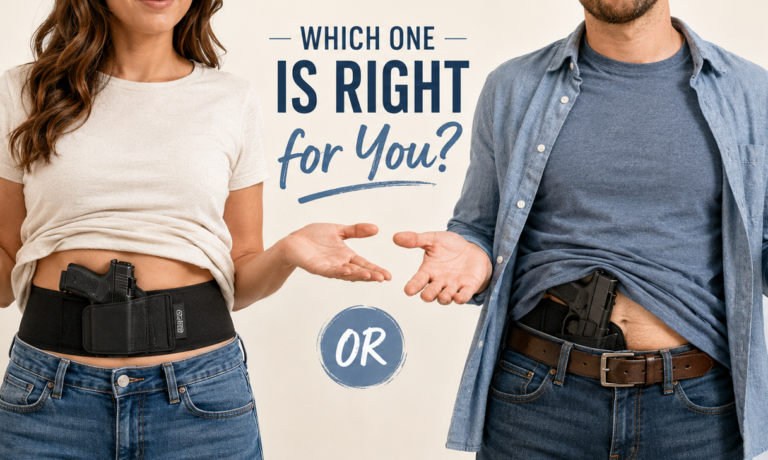
    What to Look for in a Concealed Carry Holster

    Cassie C/
    May 6, 2026

    A note from the counter: this one is written by Cassie, our co-owner. We’ve been helping people — and a lot of women specifically — figure out concealed carry for over a decade, and the holster question is the one that comes up most often. Here’s our take on the matter.

    You just got your first carry gun. Or you’re about to. And now you’re staring down hundreds of holster options online, wondering how something that’s basically a piece of plastic, fabric, or leather can come in this many flavors. If you find yourself wondering what to look for in a concealed carry holster, this post is for you.

    Here’s the first thing you should know: most people who carry every day own more than one holster. Finding the holster that disappears under your clothes, holds your gun securely, and doesn’t drive you crazy by 3 PM is a process. Almost nobody nails it on the first try. So go easy on yourself with this one, there’s no “wrong” choice at this point, just information.

    So instead of telling you which holster to buy — because the right answer depends on your body, your wardrobe, your gun, and your daily routine — we’re going to walk you through what actually matters. Once you know what to look for, you can evaluate any holster you pick up and tell a good one from a bad one in about thirty seconds.

    A quick honest note: we don’t sell holsters

    We’ll tell you up front — we don’t currently carry holsters at Good 4 Guns right now (not exactly. We have one or two, that’s it.) That might change one day. Holster fitment is so personal, and the inventory required to do it right is so wide, that we’d rather point you toward the right options than half-stock a wall and watch you walk out unhappy. Most of our customers end up ordering from manufacturer websites, specialty holster makers, or yes — Amazon — once they know what they’re looking for. This post is meant to make that shopping trip a smart one.

    First, the basics: the styles you should know about

    Most concealed carry holster guides act like there are only three options: IWB, OWB, and pocket. There are way more than that, and which one works for you depends a lot more on your body, your wardrobe, and your daily routine than on what some forum guy insists is “the only real way to carry.”

    Here’s the actual menu.

    IWB (Inside the Waistband). The holster sits between your pants and your body, with a clip that hooks over your belt. The most common concealed carry style because the gun stays close to the body and conceals well under a normal shirt. Trade-off: it takes some time to get used to something pressed against your hip all day.

    AIWB (Appendix Inside the Waistband). Same idea as IWB, but worn at the front of your body, around the front pocket area. Conceals exceptionally well under a tucked or fitted shirt, and the draw is fast and natural. Body shape matters here, and some people find it uncomfortable when sitting — but for plenty of carriers, it’s the most concealable option once they adjust.

    OWB (Outside the Waistband). The holster sits on the outside of your belt. Easier to draw from, more comfortable for longer wear, but harder to conceal. Most people use OWB for range trips, open carry where legal, or under a jacket in cooler weather.

    Concealed carry shorts and leggings. These are a quiet revolution and I love them. Built-in holster pockets — usually one on each side — let you carry without a belt, without a clip, and without anything pressed against bare skin. A lot of women’s options also have no defined “back” so you can rotate them around and carry in front or behind, depending on what you’re doing that day. (I keep my phone in one pocket and the gun in the other.) Men use these too, especially under athletic wear or for around-the-house carry. For everyday concealment under casual clothes, they’re hard to beat. My favorite come from Dene Adams.

    Belly bands. A wide elastic band that wraps around your torso with a holster pocket sewn in. These have come a long way. Old-school belly bands were basically a scratchy piece of canvas against your skin all day, and a lot of people wrote them off because of it. Modern versions use breathable fabrics, moisture-wicking liners, and adjustable retention. They work especially well under dresses, athletic wear, and anywhere a belt isn’t an option. Plenty of guys love them too.

    Bra holsters. Specifically designed for women, these come in a wide range of styles — some attach directly to the band of your bra, some are their own undergarment, some position the gun for a cross-draw, some sit at the center for a downward draw. There’s a lot more variety here than people realize, and for women carrying under fitted tops or business attire, they can be the answer when nothing else works.

    Ankle holsters. Excellent for winter — boot season is ankle holster season. They’re slow to draw from and limited to smaller, lighter guns, but as a backup or a deep-concealment option under long pants, they’re useful. Less practical in shorts and sandals weather, obviously.Shoulder harnesses. Everybody loves a good shoulder rig in the winter. They make you feel like you’re in a spy movie (be honest), and under a jacket or blazer they conceal beautifully. Not great in summer because they require a covering layer, but for cold-weather carry, especially for people who spend a lot of time driving, they’re underrated.

    The big takeaway: don’t let anyone tell you concealed carry is one shape. Especially for women, the right answer is often something other than a clip-on hip holster — and honestly, you have better places to hide things. Use the lumps, bumps, and curves to your advantage. That’s a real strategic edge, not a workaround.

    What actually matters in a good holster (any style)

    Once you’ve decided on a style, this is the checklist. A holster that nails these is a holster you’ll actually wear. A holster that misses on any of these is going to end up in your drawer.

    1. Full trigger guard coverage

    This is non-negotiable, regardless of holster style. The trigger guard — the loop of plastic or metal around the trigger — must be fully covered. No exceptions. A holster that leaves any part of the trigger exposed is dangerous, full stop. Whether you’re looking at kydex, fabric, leather, or a built-in pocket on a pair of carry shorts, the first thing to check is whether the entire trigger area is enclosed and protected from anything pressing against it.

    This is why a lot of people advise against universal “one size fits most” soft holsters: they can shift, fold, or sag, and a folded fabric edge can press into the trigger when you’re reholstering. Hard-shell holsters molded to your specific gun model don’t have this problem.

    2. Made specifically for your gun

    A holster molded for a Glock 19 will not work properly with a Sig P365, even if the gun “fits.” Generic holsters might hold the gun, but they won’t retain it the way a model-specific holster does, and the fit affects everything from comfort to safety. When you shop, look for a holster that lists your exact make and model — including whether it’s optic-cut or has a light or laser attached.

    This is more flexible with belly bands and carry shorts, where the holster pocket is designed to fit a range of guns. Even there, you want one that’s sized appropriately — a pocket built for a full-size 1911 will swallow a Sig P365 and let it shift around.

    3. Solid retention

    Retention is how well the holster holds the gun in place when you’re moving around. A good holster makes a satisfying click when you reholster, and you can flip it upside down without the gun falling out. Most quality kydex holsters have an adjustable retention screw — usually a small Allen screw on the holster body — so you can dial it tighter or looser to your preference.

    For belly bands and bra holsters, retention usually comes from elastic tension and a snap or strap. Test it. Walk around. Bend over. Reach up. If the gun shifts noticeably, the retention isn’t enough.

    4. A real belt clip or anchoring system

    For IWB, AIWB, and OWB, the clip is the unsung hero. A cheap plastic clip that hooks loosely over a thin belt is going to flex, twist, or come unclipped at the worst possible time. Look for a clip that hooks fully under the belt (not just on top of it), is rigid enough not to flex when you draw, and fits the width of your actual carry belt.

    Speaking of which — if you don’t have a real gun belt, consider getting one. A regular dress belt or a thin canvas belt will sag under the weight of a loaded gun, and your “concealment” will look exactly like what it is. A proper gun belt is stiffer, thicker, and built to support the load. It transforms how every belt-based holster on your body performs.

    For carry shorts, leggings, belly bands, and bra holsters, the equivalent question is: how is the holster anchored to your body? Is it staying put when you move, sit, bend, and reach? If not, the anchor isn’t doing its job.

    5. Comfort that doesn’t compromise safety

    Here’s where most beginners get tripped up: a holster that’s too comfortable to wear is often a holster that’s not doing its job. A bit of pressure against your body is normal — it’s how the holster stays put. What you’re looking for isn’t “pillow soft.” It’s “I forget I’m wearing it after about an hour.”

    The biggest comfort variables are the holster’s edges (sharp edges dig in — look for smoothed or rolled edges), the cant (the angle the gun sits at — adjustable cant is great for finding what works), and the ride height (how high or low the gun sits relative to your belt or anchor — too high and the grip prints through your shirt; too low and the draw gets awkward).

    6. Easy, one-handed reholstering

    You should be able to reholster with one hand, without looking, without fishing around for the opening. A holster that collapses or folds when the gun is out — common with some soft fabric holsters — forces you to use your support hand to hold the holster open while you reholster. That’s a safety issue. A rigid or reinforced holster keeps its shape, and reholstering becomes a smooth, confident motion. I put this last on purpose. It’s MORE important that you can get your gun out quickly- getting it back in quickly is also important, but if I find a holster that is comfortable, secure, and easy to get my gun OUT of, I’ll compromise a two-handed reholster for those boxes to get checked.

    The materials: a quick honest take

    Kydex is rigid, molded plastic. Pros: holds its shape, consistent retention, easy to clean, lightweight. Cons: can be noisy, a little less forgiving against the body. Most quality concealed carry holsters today are kydex.

    Leather is traditional, comfortable against the body, and ages well. Cons: takes time to break in, can wear over the years, retention isn’t adjustable.

    Hybrid (leather + kydex) combines a leather backing for comfort with a kydex shell for retention. Sounds like the best of both worlds, and for some people it is — but the extra material can add bulk, and over time the leather can soften enough that retention loosens.

    Modern technical fabrics — used in better belly bands, carry shorts, and bra holsters — have come a long way. Look for breathable, moisture-wicking liners and reinforced holster pockets that keep their shape.

    For most beginners going the traditional route, a quality kydex holster molded for your specific gun is the safest, most reliable starting point. For everyone else, the alternative styles above are absolutely valid.

    What we actually tell people at the counter

    When someone walks in and says “I just got my first carry gun and I need a holster,” here’s the honest version:

    Figure out your real wardrobe and routine first. A perfect IWB holster is useless if you wear dresses to work three days a week. A bra holster won’t help you if you live in athletic wear and tank tops. An ankle rig is useless if you spend 90% of your time in shorts. Match the holster to your actual life, not the life you think you should have.

    Plan on spending somewhere between $60 and $100 on a quality holster. Cheaper than that and you’re usually getting something that’s going to fail the checklist above. More than that, and you’re paying for craftsmanship and customization that doesn’t always change the safety or function — though if you find a $200 holster that you love and wear every day, that’s money well spent.

    Wear it for two weeks before you give up on it. Unless there is a real clear “no” give it a chance or two. Holsters break in. Bodies adjust. What feels weird on day one often feels invisible by day fourteen. If after two weeks it’s still wrong, then try something else.

    Build a small rotation. Most experienced carriers have two or three holsters they actually use — usually one for everyday clothes, one for dressier or warm-weather situations, and one for something specific (the gym, a certain outfit, a season). That’s normal.

    A few things you don’t have to worry about yet

    If you’re brand new to carrying, ignore most of the internet’s holster discourse. You don’t need to think about:

    • Light-bearing holsters (unless your gun has a weapon light)
    • Optics-cut holsters (unless your gun has a red dot)
    • Soft loops vs. hard clips vs. claw attachments (these get fine-tuned later)
    • Custom kydex colors and patterns (just kidding, if you love it you’ll wear it. Don’t let anyone tell you something can’t be functional and still look nice. That’s weird.)

    When in doubt, talk to someone who’s been there

    Holster shopping is personal. Your body, your wardrobe, your daily routine, your gun — all of it matters. If you’re stuck or overwhelmed, come by the shop and ask. We’ve helped a lot of people through this, and even though we don’t sell the holsters themselves, we can tell you what’s worked for people built like you, dressed like you, and living a life like yours.

    There’s no pressure, no upsell, and no judgment. Concealed carry is one of those things where what looks great in a product photo can feel completely wrong on your body — and what looks plain and unremarkable can be the holster you wear every day for the next ten years.

    Take your time. Ask questions. Try things. You’ll find your perfect match, and probably 5 or 6 more as well.

  • Oliver looking happy with his Oliver-sized AR. (which, by the way, he bought at Good 4 Guns. It's ok. He's 28 in people years)

    What Nobody Tells You About Buying Your First AR-15

    g4gguns/
    May 5, 2026

    You’ve decided to look into buying your first AR-15. You went online to do some research. And now you’re more confused than when you started, because someone on Reddit told you anything under $1,500 is garbage, a YouTube guy says you need to build your own, and your buddy swears by a brand you’ve never heard of.

    Welcome to the AR-15 buying experience. It doesn’t have to be like this.

    We’ve helped hundreds of first-time AR buyers at our counter, and the conversation is almost always the same: they come in overwhelmed, we ask them a few questions, and twenty minutes later they leave with a rifle they’re excited about instead of confused by. This article is that conversation, written down.

    First: What “AR” Actually Stands For

    Let’s get this out of the way because it matters. AR does not stand for “assault rifle.” It stands for ArmaLite Rifle, named after the company that designed the platform in the 1950s. The AR-15 is a semi-automatic rifle — one trigger pull, one round. This distinction matters because the terminology shapes perception, and if you’re going to own one, you should be able to explain what it is when someone asks.

    The Numbers Don’t Mean What You Think

    This is the part that trips up almost every first-time buyer. You’ll see specs like 5.56 NATO, .223 Remington, 1:7 twist, 1:8 twist, carbine-length gas, mid-length gas, direct impingement, piston-driven — and none of it means anything to you yet. Here’s what actually matters right now:

    Caliber: Go with 5.56 NATO. A rifle chambered in 5.56 will also safely shoot .223 Remington, which gives you the widest ammo selection at the best prices. This is not a decision you need to overthink for your first AR. Other calibers exist and they’re interesting, but they’re for your second rifle, not your first.

    Barrel length: 16 inches. This is the legal minimum for a rifle barrel without getting into short-barreled rifle regulations. It’s the most common, the most versatile, and what virtually every manufacturer optimizes around. Shorter barrels exist and they’re cool, but they add legal complexity and cost that you don’t need right now.

    Twist rate: 1:7 or 1:8. Both work perfectly with standard 55-grain and 62-grain ammo. This spec matters a lot to precision shooters and basically not at all to you right now. Either one is fine.

    Gas system: Mid-length is ideal, carbine-length is fine. A mid-length gas system is a little smoother and a little softer on recoil. Carbine-length is more common on entry-level rifles and works perfectly well. You will not notice the difference at the range. You might notice it at round 500. Either way, it’s not a dealbreaker.

    Everything else — the handguard material, the stock type, the grip angle, the muzzle device — is preference, not performance. You can change all of that later. Don’t let it paralyze your purchase.

    Buy Your First One. Build Your Second.

    The internet will tell you to build your own AR-15. The internet is not wrong, but the internet is also not standing in front of you at the counter watching your eyes glaze over when someone explains headspacing.

    Your first AR should be a complete, factory-assembled rifle from a reputable manufacturer. Take it out of the box, add oil, load a magazine, and shoot. No torque wrenches, no barrel nut installations, no “did I stake the gas key properly” anxiety. A factory rifle comes assembled correctly, headspaced correctly, and backed by a manufacturer’s warranty. That peace of mind matters when you’re new.

    Build your second one. By then you’ll understand the platform, you’ll know what you like and don’t like about your first rifle, and you’ll have opinions about triggers and handguards that are based on experience instead of forum arguments. Building is educational, satisfying, and often saves money on mid-range and premium rifles. But it’s a terrible first step.

    How Much Should You Actually Spend?

    This is where the internet gets the loudest and the most wrong. Here’s the truth: a reliable, accurate AR-15 that will serve you well for years starts at around $450–$500 in 2026. You do not need to spend $1,500 on your first rifle.

    $450–$600: Entry-level rifles from Smith & Wesson (M&P Sport series), Ruger (AR-556), and Palmetto State Armory (PA-15). These are reliable, well-built, and will do everything a new shooter needs. They won’t have premium triggers or free-float handguards, but those are upgrades you can make later if you want them.

    $600–$1,000: Mid-range rifles from Springfield (SAINT series), IWI (Zion-15), Sig Sauer, and Aero Precision. Better triggers, free-float handguards, and nicer fit and finish. This is the sweet spot for a rifle you probably won’t feel the need to upgrade for a long time.

    $1,000–$1,500+: Premium rifles from BCM, Daniel Defense, and similar. These are genuinely excellent. But for a first-time buyer who doesn’t yet know what they like, spending this much is like buying a performance car before you have your license. You’ll appreciate it more later.

    Our honest advice: Spend $500–$800 on the rifle and save $200–$300 for a basic red dot sight, a sling, and ammo. A trained shooter with a $500 rifle will outperform an untrained shooter with a $2,000 rifle every single time. The money you save on the gun should go toward rounds downrange.

    The Accessories Trap

    This is the thing nobody tells you, and it’s the thing that costs first-time buyers the most money and the most frustration.

    You’re going to buy the rifle, get excited, and immediately want to add a red dot, a magnifier, a weapon light, a vertical grip, a new stock, a new trigger, a bipod, a laser, and backup iron sights. Your cart will hit $800 in accessories before you’ve fired a single round. Don’t do this to yourself.

    Start with three things and only three things:

    A red dot sight. A Sig Romeo5 (~$120) or Holosun 403B (~$150) is all you need. Both-eyes-open shooting with a red dot is faster and more intuitive than iron sights for most people. Skip the $35 Amazon red dot — it won’t hold zero and you’ll replace it in a month.

    A two-point sling. $30–$50. A sling is to a rifle what a holster is to a handgun — it’s how you carry it when you’re not shooting it. It also stabilizes your shot. This is not optional; it’s just overlooked.

    Ammo. Buy a case (500–1,000 rounds) of brass-cased 55-grain FMJ. Federal American Eagle, PMC Bronze, or Winchester White Box are all fine for practice. Budget around 30–40 cents per round in 2026. The best accessory for any rifle is trigger time.

    Everything else can wait until you’ve shot enough to know what you actually want. The bipod, the magnifier, the weapon light — those are solutions to problems you haven’t discovered yet. Shoot first. Shop later.

    The AR-15 Likes to Run Wet

    This surprises a lot of new owners, especially if they came from handguns. The AR-15 platform runs best with generous lubrication. A dry AR is an unreliable AR. Before your first range trip, apply CLP or gun oil liberally to the bolt carrier group — the rails, the cam pin area, the bolt rings. When in doubt, add more. You’re not going to over-lubricate an AR the way you might over-lubricate a handgun. This platform was designed to run wet in sandy, dirty, harsh environments. Feed it oil and it’ll feed you reliability.

    Clean it after every range session for the first few hundred rounds. After that, you can extend to every 500–1,000 rounds if you’re keeping it lubricated. A bore snake and a bottle of CLP is all you need for routine maintenance. Fifteen minutes, tops.

    The One Thing the Internet Gets Right

    Here’s the one piece of advice from every forum, every YouTube channel, and every gun store employee that is absolutely correct: your first AR does not need to be perfect. It needs to be reliable, simple, and from a manufacturer who will stand behind it.

    You are going to learn more about what you want from an AR-15 in your first 500 rounds than you will from 500 hours of online research. The barrel length you thought you wanted might feel wrong. The stock that looked cool online might not fit your body. The trigger might be fine, or it might drive you crazy. You won’t know any of this until you shoot it.

    Buy the rifle. Shoot the rifle. Learn from the rifle. Then build the next one exactly the way you want it, with opinions earned at the range instead of borrowed from the internet.

    Come In and Handle One

    If you’ve never held an AR-15, the first time you pick one up will surprise you. They’re lighter than most people expect. The recoil is softer than most people expect. And the controls are more intuitive than they look in pictures. We keep several entry-level and mid-range ARs in stock, and we’re happy to walk you through the platform, explain what everything does, and help you figure out what makes sense for your budget and your needs. No pressure, no judgment, no quiz. That’s what we’re here for.

0
    0
    Your Cart
    Your cart is emptyReturn to Shop