
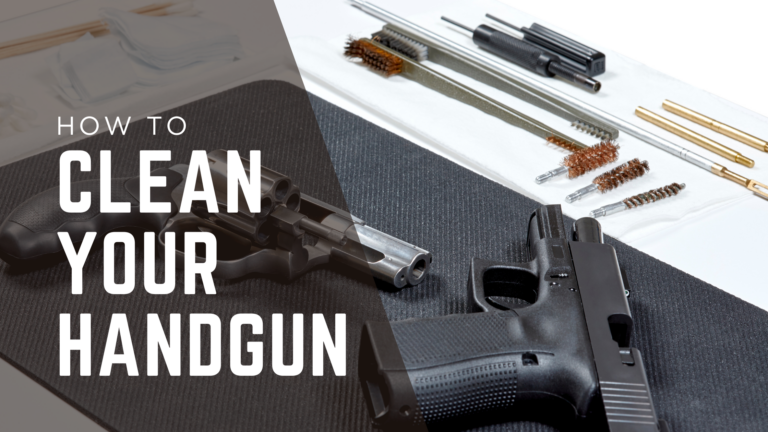
You bought the gun. You shot the gun. Now the gun needs to be cleaned, and you’re staring at it on the kitchen table wondering where to start.
We get it. This isn’t the glamorous part. The buying guides, the range tips, the carry articles — they all stop right before the part where you’re sitting at home with a dirty gun, a YouTube video that’s way too fast, and no idea how much oil is too much oil. This is the guide we wish someone had given us when we started.
This covers semi-automatic handguns (the most common type). If you have a revolver, the process is similar but the disassembly is different — we’ll cover that in a future post. And if your gun came with an owner’s manual, keep it nearby. Every model is slightly different in how it comes apart, and the manual is your cheat sheet.
What You’ll Need
You don’t need a lot, and you don’t need to spend a fortune. Here’s what we recommend for a basic cleaning kit:
Cleaning solvent — We love Real Avid’s Bore Max Solvent. It smells like your grandfather’s gun cabinet and it works. CLP (Clean, Lubricate, Protect) products like Tri Max CLP are an all-in-one option if you want to keep it simple.
Lubricant/gun oil — If you’re using a dedicated solvent like Bore Max, you’ll need a separate lubricant. If you’re using CLP, it does double duty. Either way, a little goes a long way. More on that later.
Bore brush — A small brush (usually bronze or nylon) sized for your caliber. This scrubs the inside of the barrel.
Cleaning rod or bore snake — A rod pushes patches through the barrel. A bore snake is a pull-through alternative that’s faster and easier for routine cleaning. If you’re buying one thing for convenience, get a bore snake.
Cleaning patches — Small cotton or microfiber squares that attach to the cleaning rod. You’ll go through a few per session.
Nylon brush — An old toothbrush works fine. This is for scrubbing carbon off the slide, frame, and small parts.
Microfiber cloth or clean rags — For wiping everything down. Use something you don’t care about because it’s going to get dirty.
A complete cleaning kit with everything listed above runs $15–$30 and will last you a long time. We carry several in the store if you want to grab one next time you’re in.
Step 1: Make It Safe
This is the most important step in this entire article, and it is not optional.
Remove the magazine. Lock the slide back. Look into the chamber and visually confirm it is empty. Set the magazine aside, away from your workspace. Point the muzzle in a safe direction the entire time.
Every year, people are hurt by guns they were “certain” were unloaded. Don’t assume. Verify. Every single time.
Step 2: Field Strip the Gun
Field stripping means taking the gun apart into its main components — usually no tools required, no advanced knowledge needed. For most semi-automatic pistols, you’ll end up with four pieces: the frame, the slide, the barrel, and the recoil spring/guide rod.
How you get there depends on the gun. Some have takedown tabs you pull down. Others have a takedown lever you rotate. This is where your owner’s manual earns its keep. If you don’t have it, the manufacturer’s website will have a digital version you can download for free.
Pro tip: The first time you field strip your gun, do it slowly and pay attention to how each piece comes out. Reassembly is just the reverse, and it’s much easier when you remember the order.
Step 3: Clean the Barrel
The barrel is the most important part to clean. Carbon, lead, and copper fouling build up inside the rifling every time you shoot, and that buildup affects accuracy over time.
If you’re using a cleaning rod: Apply solvent to a bore brush and push it through the barrel from the chamber end (the back) out through the muzzle (the front). Do this five to ten times. Then switch to a solvent-soaked cleaning patch on a jag or patch holder and push it through. Repeat with fresh patches until the patch comes out without heavy black residue. It doesn’t need to be perfectly white — just reasonably clean.
If you’re using a bore snake: Apply a few drops of solvent to the front section of the snake, drop the weighted end through the chamber, and pull the whole thing through three or four times. That’s it. Bore snakes are the reason busy people actually clean their guns.
Direction matters: Always go from chamber to muzzle. Pulling a dirty brush or patch backward pushes fouling back into the gun and can damage the crown of the barrel over time.
Step 4: Clean the Slide
The inside of the slide collects carbon, powder residue, and general grime — especially around the breech face (where the back of the cartridge sits), the extractor, and the area around the firing pin hole. If you carry daily, you’ll also find lint, dust, and debris from the holster. One of our favorite gun writers described his carry gun’s slide as looking like a Wookiee had been carrying it, and that’s about right.
Wipe the inside of the slide down with a solvent-dampened cloth. Use your nylon brush (or old toothbrush) to scrub stubborn carbon deposits. Pay attention to the slide rails — those grooves on either side that the slide rides on. They should be clean and smooth.
Note: Avoid flooding solvent into the striker/firing pin channel unless you’re comfortable taking the striker assembly apart for a deep clean. For routine maintenance, just brush around the firing pin hole and wipe it down.
Step 5: Clean the Frame
The frame houses the trigger group and the feed ramp (the small polished ramp that guides cartridges into the chamber). Carbon accumulates around the top of the magazine well and along the slide rail grooves.
Wipe it down with a cloth. Use your brush on stubborn spots. Be gentle around the trigger mechanism — you don’t need to disassemble it for routine cleaning, and most manufacturers recommend you don’t. Avoid spraying aerosol solvents directly into the frame, as the excess will run into small parts and mechanisms where it doesn’t belong.
Step 6: Clean the Recoil Spring and Guide Rod
These usually just need a wipe-down. If there’s visible carbon or grime, hit them with the nylon brush and a little solvent. This is the fastest step and takes about thirty seconds.
Step 7: Lubricate
This is where most new owners make a mistake, and the mistake is almost always using too much.
A handgun needs a thin film of oil on its moving parts, not a soaking. Excess oil attracts dirt and dust, gunks up the action over time, and can actually cause malfunctions. If oil is dripping off any part of your gun, you’ve used too much.
Apply a small drop of oil or CLP to each slide rail on the frame, the barrel’s exterior where it contacts the slide, and any other metal-on-metal contact points your owner’s manual identifies. Then work the slide back and forth a few times to distribute the lubricant evenly. Wipe off any excess with your cloth.
The rule of thumb: if you can see the oil, you might have too much. You want a light sheen, not a puddle.
Step 8: Reassemble and Function Check
Put the gun back together in reverse order. Barrel and recoil spring go back into the slide, slide goes back onto the frame. Again, your owner’s manual will walk you through this if you get stuck.
Once reassembled, do a quick function check: rack the slide to make sure it moves smoothly, pull the trigger to verify it clicks (the gun should be confirmed empty and pointed in a safe direction), and check that the magazine seats properly. Your owner’s manual will tell you if dry-firing is not recommended, in which case dummy rounds are perfect for the task. If anything feels off — the slide is catching, the trigger doesn’t reset, something’s not sitting right — field strip it again and make sure everything went back in correctly.
How Often Should You Clean Your Handgun?
After every range session. This is the standard recommendation, and it’s a good habit to build, especially as a new owner. It only takes 10–15 minutes once you’ve done it a few times, and it gives you a chance to inspect the gun for anything unusual.
If you carry daily: Give it a wipe-down and light cleaning at least once a month, even if you haven’t shot it. Carry guns collect lint, moisture, and body oils from the holster. A gun that sits in a holster all day every day without being cleaned is accumulating grime that can affect reliability when it matters most.
If it’s a home defense gun that doesn’t get shot often: Inspect and clean it every few months. Make sure it’s not collecting dust, that the oil hasn’t dried out, and that everything functions smoothly. A nightstand gun you haven’t touched in six months deserves a once-over before you trust it with your life.
Mistakes We See New Owners Make
“I forgot to check if it was loaded.” We said it at the top and we’ll say it again. Check. Then check again. Then check a third time. This is not dramatic — it’s what every experienced gun owner does, every single time.
“I used way too much oil.” Almost everyone does this the first time. A dripping wet gun is not a well-maintained gun. Less is more.
“I never cleaned it because I wasn’t sure how.” This is the most common one, and it’s the reason this article exists. A gun you’re afraid to clean is a gun you don’t fully own yet. The first time is awkward. The second time is easier. By the third time, it’s ten minutes and muscle memory. One of our favorite customers is an elderly woman who regularly comes in to tell us her beloved Walther PK380 no longer functions. Every time the culprit is hundreds of rounds of range fun with zero cleaning. She’s a range baddie and we love her for it.
“I cleaned it on the white couch.” That couch is not white anymore. Use a gun cleaning mat or an old towel on a hard surface, somewhere well-ventilated. Solvents have fumes, carbon is messy, and gun oil stains everything it touches.
Need a Kit? Need Help?
We carry cleaning kits, solvents, lubricants, bore snakes, and everything else mentioned in this article. If you’re not sure what to buy or you’d rather have someone walk you through it in person the first time, come in and ask. We’ll show you how to field strip and clean your specific gun. It takes ten minutes, costs nothing, and you’ll walk out knowing how to take care of what you own.
Your gun is a tool. Treat it like one. Keep it clean, keep it oiled, and it will work when you need it to.