
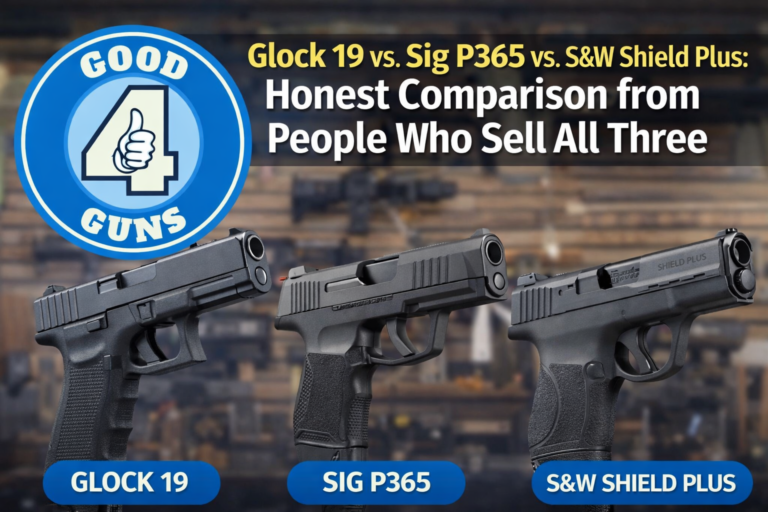
Honest Comparison from People Who Sell All Three
These are the three guns that come up in almost every concealed carry conversation. Walk into any gun store in America — ours included — and say “I want to carry,” and the person behind the counter is going to mention at least one of these within the first sixty seconds. So let’s compair: Glock 19 vs Sig P365 vs S&W Shield Plus.
The internet is full of comparisons between these three, and most of them are written by people who got one gun, fell in love with it, and then wrote an article explaining why it’s better than the other two. That’s not what this is. We sell all three. We hear what customers say after they buy each one. We see which ones come back for issues and which ones customers rave about for years. That’s the data we’re working from.
Here’s the thing nobody wants to say up front: all three of these guns are excellent. You cannot make a bad choice between them. The question isn’t which one is best — it’s which one is best for you, your body, your wardrobe, your lifestyle, and how you plan to use it. That’s what we’re going to help you figure out.
The Numbers at a Glance
| GLOCK 19 GEN 5 | SIG P365 | S&W SHIELD PLUS | |
| Caliber | 9mm | 9mm | 9mm |
| Capacity | 15+1 | 10+1 / 12+1 / 15+1 | 10+1 / 13+1 |
| Barrel | 4.02” | 3.1” | 3.1” |
| Overall Length | 7.36” | 5.8” | 6.1” |
| Height | 5.04” | 4.3” | 4.5” |
| Width | 1.26” | 1.0” | 1.0” |
| Weight (empty) | 23.6 oz | 17.8 oz | 20.0 oz |
| Street Price | ~$450–$500 | ~$430–$500 | ~$350–$450 |
| Optics Ready | MOS version ($550+) | Most models standard | Some models (OR/TS) |
| Category | Compact | Micro-compact | Micro-compact / subcompact |
One thing jumps out of this table immediately: the Glock 19 is a different size class. It’s a compact, not a micro-compact. Comparing it to the P365 and Shield Plus is a little like comparing a sedan to two hatchbacks — they all get you to work, but they’re solving the problem differently. We’re including it because this is the comparison people actually make, not the one that makes the most technical sense.
Size and Concealability
The Sig P365 is the smallest of the three and it’s not close. At just over an inch wide and under 18 ounces empty, this gun disappears under a t-shirt in Texas summer. It was designed from the ground up for deep concealment, and it succeeds. If your primary concern is “will people know I’m carrying,” the P365 is your answer.
The Shield Plus is nearly identical in width to the P365 (both are essentially 1 inch) and only marginally larger in every other dimension. The practical concealment difference between these two is minimal for most body types. Where the Shield has a slight edge is the grip — it’s just a hair longer, which means more of your hand gets on the gun. That matters for shooting comfort, which we’ll get to.
The Glock 19 is noticeably larger and heavier. A quarter-inch wider, almost an inch and a half longer, and nearly six ounces heavier. For people who dress around the gun — jacket weather, untucked flannel, larger frame — it conceals fine. For shorts-and-a-t-shirt carry, it takes more effort and a good holster. It’s the gun you might choose to leave at home on certain days, which is a real factor if you want to carry every day.
How They Shoot
This is where the Glock 19 earns its spot in the conversation. A bigger gun is easier to shoot well. The longer sight radius, the additional weight absorbing recoil, the larger grip filling your hand — all of this adds up. At the range, the G19 is the most pleasant of these three to shoot for extended sessions. If you’re putting 200 rounds downrange on a Saturday, the Glock will leave your hand feeling the best afterward.
The Shield Plus comes in second and it’s closer than you’d expect. The trigger is widely considered the best of the three out of the box — a crisp, clean break that surprises people who expect a budget feel from Smith & Wesson. Recoil is manageable. Multiple customers have told us the Shield Plus shoots better than compact guns twice its size, and our experience backs that up.
The P365 is the snappiest of the three because it’s the lightest. That’s physics, not a flaw. The trigger is good but not as smooth as the Shield, and the smaller grip means less to hold onto during recoil. None of this makes it a bad shooter — it’s remarkably accurate for its size. But if you’re recoil-sensitive or have larger hands, you’ll notice the difference during a longer range session.
Capacity
The Glock 19 wins this category with 15+1 standard. That’s a lot of rounds in a defensive handgun, and it’s one of the reasons law enforcement agencies around the world use some version of this platform.
The Shield Plus surprised the market when it launched with 13+1 capacity in a micro-compact frame. That’s only two rounds less than the Glock in a significantly smaller package. With the flush 10-round magazine, it’s 10+1 — still competitive.
The P365 starts at 10+1 with the flush magazine, which was groundbreaking when it launched. Extended magazines bring it to 12+1 or 15+1. The 15-round magazine does make the grip longer, which changes the concealment profile, but it gives you Glock 19 capacity in a much smaller gun when you want it.
Reliability
We’re going to be honest here because this matters more than anything else on this page.
The Glock 19 has the longest track record of the three, and its reliability is essentially legendary. Versions of this gun have been in service since 1988. It runs dirty, it runs wet, it runs dry, it runs with cheap ammo. We have customers with thousands of rounds through their G19 who have never experienced a malfunction. If reliability is your single highest priority, the Glock’s resume is unmatched.
The Shield Plus is built on the Shield platform, which has been a proven performer since 2012. Smith & Wesson refined it with the Plus variant and the result is a gun with an excellent reliability record. We’ve sold a lot of these and the complaint rate is essentially zero.
The P365 had some well-documented issues in its first year of production — broken strikers and primer drag being the most notable. Sig addressed those problems, and current production P365s run well. But that early history exists, and if you buy used, production date matters. New off the shelf today? We’d trust any of the three equally.
Trigger
This is surprisingly important for a defensive handgun, and it’s where opinions get strong.
The Shield Plus has the best trigger of the three out of the box. Flat-faced, crisp break, tactile reset. It genuinely feels like a trigger from a gun costing $200 more. This is the single biggest differentiator Smith & Wesson has over the competition in this comparison, and they know it.
The P365’s trigger is good — smooth, consistent pull with a clean break. It’s a step below the Shield but a step above many competitors.
The Glock 19’s trigger is… fine. It’s the Glock trigger. Millions of people shoot it just fine. Millions of others immediately swap it for an aftermarket option. It’s mushy, the reset is long, and it’s the most common complaint about an otherwise flawless gun. The aftermarket fixes this for $30–$75, but out of the box, it finishes last here.
Aftermarket and Ecosystem
The Glock 19 wins this category by a mile. The aftermarket ecosystem for Glock is the largest of any handgun on the planet. Holsters, sights, triggers, slides, barrels, frames, lights, mag extensions — if you can imagine it, someone makes it for a Glock. You can start with a stock G19 and turn it into a completely different gun over time. This is one of its biggest long-term advantages.
The P365 has a growing aftermarket and Sig’s modular FCU system lets you swap grip modules, slides, and configurations without buying a new gun. The Sig Custom Works builder lets you configure one online. The ecosystem isn’t as deep as Glock’s, but it’s robust and expanding. Holster availability is excellent.
The Shield Plus has good aftermarket support — holsters are plentiful, sights and triggers are available. It’s not as customizable as the Glock or as modular as the Sig, but most people who buy a Shield aren’t looking to build a project gun. They’re looking for something that works great right out of the box, and that’s exactly what it delivers.
So Which One Should You Buy?
Buy the Glock 19 if: You want one gun that does everything. Home defense, range day, concealed carry in cooler weather, nightstand gun. You don’t mind the larger size. You like the idea of customizing over time. You value a proven track record above all else. This is the Swiss Army knife.
Buy the Sig P365 if: Concealment is your top priority. You live in a warm climate and wear light clothing. You have a smaller frame or smaller hands. You want maximum capacity in the smallest possible package. You like having the option to switch between subcompact and compact configurations with different grip modules. This is the disappearing act.
Buy the Shield Plus if: You want the best trigger and the best out-of-the-box shooting experience in a micro-compact. You want something proven and simple that doesn’t need modifications to be great. You’re budget-conscious — at $350–$450 it’s consistently the most affordable of the three. You want a gun that everyone who shoots it says “that’s better than I expected.” This is the sleeper pick.
Our Spicy Opinion
If we could only stock one of these three guns in the store and sell it to every first-time carry customer who walked through the door, it would be the Shield Plus. Not because it’s the best gun on this list — there is no best gun on this list — but because it has the fewest compromises for the widest range of people. The trigger is excellent. The size is right. The price is fair. It shoots better than it has any right to at this size. And nobody has ever come back and told us they regretted buying one.
The Glock and Sig loyalists are welcome to fight us in the comments. We’ll be here.
The Best Way to Decide
Come in and hold all three. Seriously. The specs and comparisons only get you so far. How a gun feels in your hand, how the trigger pull feels to your finger, how the grip angle sits against your palm — that’s what makes the decision for you. We keep all three in stock and we’re happy to let you handle them side by side with zero pressure. Bring your questions. We’ll be honest.