

A note from the counter: this one is written by Cassie, our co-owner. We’ve been helping people — and a lot of women specifically — figure out concealed carry for over a decade, and the holster question is the one that comes up most often. Here’s our take on the matter.
You just got your first carry gun. Or you’re about to. And now you’re staring down hundreds of holster options online, wondering how something that’s basically a piece of plastic, fabric, or leather can come in this many flavors. If you find yourself wondering what to look for in a concealed carry holster, this post is for you.
Here’s the first thing you should know: most people who carry every day own more than one holster. Finding the holster that disappears under your clothes, holds your gun securely, and doesn’t drive you crazy by 3 PM is a process. Almost nobody nails it on the first try. So go easy on yourself with this one, there’s no “wrong” choice at this point, just information.
So instead of telling you which holster to buy — because the right answer depends on your body, your wardrobe, your gun, and your daily routine — we’re going to walk you through what actually matters. Once you know what to look for, you can evaluate any holster you pick up and tell a good one from a bad one in about thirty seconds.
A quick honest note: we don’t sell holsters
We’ll tell you up front — we don’t currently carry holsters at Good 4 Guns right now (not exactly. We have one or two, that’s it.) That might change one day. Holster fitment is so personal, and the inventory required to do it right is so wide, that we’d rather point you toward the right options than half-stock a wall and watch you walk out unhappy. Most of our customers end up ordering from manufacturer websites, specialty holster makers, or yes — Amazon — once they know what they’re looking for. This post is meant to make that shopping trip a smart one.
First, the basics: the styles you should know about
Most concealed carry holster guides act like there are only three options: IWB, OWB, and pocket. There are way more than that, and which one works for you depends a lot more on your body, your wardrobe, and your daily routine than on what some forum guy insists is “the only real way to carry.”
Here’s the actual menu.
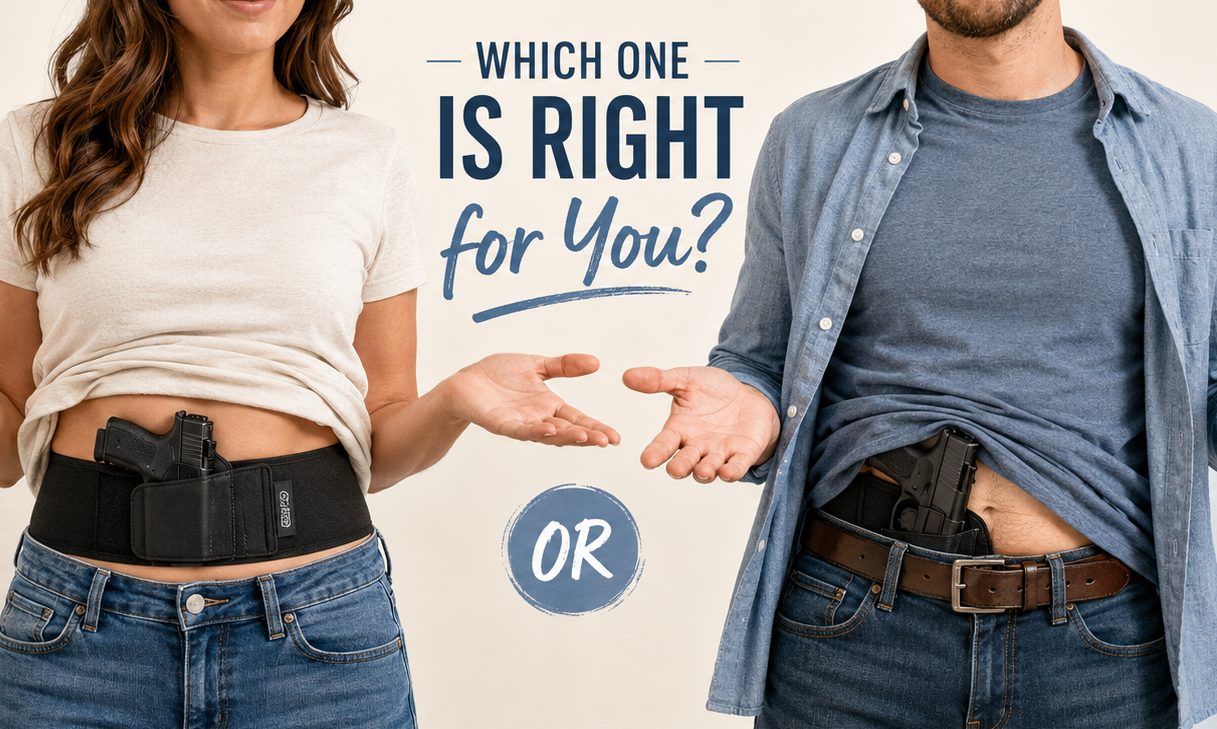
IWB (Inside the Waistband). The holster sits between your pants and your body, with a clip that hooks over your belt. The most common concealed carry style because the gun stays close to the body and conceals well under a normal shirt. Trade-off: it takes some time to get used to something pressed against your hip all day.
AIWB (Appendix Inside the Waistband). Same idea as IWB, but worn at the front of your body, around the front pocket area. Conceals exceptionally well under a tucked or fitted shirt, and the draw is fast and natural. Body shape matters here, and some people find it uncomfortable when sitting — but for plenty of carriers, it’s the most concealable option once they adjust.
OWB (Outside the Waistband). The holster sits on the outside of your belt. Easier to draw from, more comfortable for longer wear, but harder to conceal. Most people use OWB for range trips, open carry where legal, or under a jacket in cooler weather.
Concealed carry shorts and leggings. These are a quiet revolution and I love them. Built-in holster pockets — usually one on each side — let you carry without a belt, without a clip, and without anything pressed against bare skin. A lot of women’s options also have no defined “back” so you can rotate them around and carry in front or behind, depending on what you’re doing that day. (I keep my phone in one pocket and the gun in the other.) Men use these too, especially under athletic wear or for around-the-house carry. For everyday concealment under casual clothes, they’re hard to beat. My favorite come from Dene Adams.
Belly bands. A wide elastic band that wraps around your torso with a holster pocket sewn in. These have come a long way. Old-school belly bands were basically a scratchy piece of canvas against your skin all day, and a lot of people wrote them off because of it. Modern versions use breathable fabrics, moisture-wicking liners, and adjustable retention. They work especially well under dresses, athletic wear, and anywhere a belt isn’t an option. Plenty of guys love them too.
Bra holsters. Specifically designed for women, these come in a wide range of styles — some attach directly to the band of your bra, some are their own undergarment, some position the gun for a cross-draw, some sit at the center for a downward draw. There’s a lot more variety here than people realize, and for women carrying under fitted tops or business attire, they can be the answer when nothing else works.
Ankle holsters. Excellent for winter — boot season is ankle holster season. They’re slow to draw from and limited to smaller, lighter guns, but as a backup or a deep-concealment option under long pants, they’re useful. Less practical in shorts and sandals weather, obviously.Shoulder harnesses. Everybody loves a good shoulder rig in the winter. They make you feel like you’re in a spy movie (be honest), and under a jacket or blazer they conceal beautifully. Not great in summer because they require a covering layer, but for cold-weather carry, especially for people who spend a lot of time driving, they’re underrated.
The big takeaway: don’t let anyone tell you concealed carry is one shape. Especially for women, the right answer is often something other than a clip-on hip holster — and honestly, you have better places to hide things. Use the lumps, bumps, and curves to your advantage. That’s a real strategic edge, not a workaround.
What actually matters in a good holster (any style)
Once you’ve decided on a style, this is the checklist. A holster that nails these is a holster you’ll actually wear. A holster that misses on any of these is going to end up in your drawer.
1. Full trigger guard coverage
This is non-negotiable, regardless of holster style. The trigger guard — the loop of plastic or metal around the trigger — must be fully covered. No exceptions. A holster that leaves any part of the trigger exposed is dangerous, full stop. Whether you’re looking at kydex, fabric, leather, or a built-in pocket on a pair of carry shorts, the first thing to check is whether the entire trigger area is enclosed and protected from anything pressing against it.
This is why a lot of people advise against universal “one size fits most” soft holsters: they can shift, fold, or sag, and a folded fabric edge can press into the trigger when you’re reholstering. Hard-shell holsters molded to your specific gun model don’t have this problem.
2. Made specifically for your gun
A holster molded for a Glock 19 will not work properly with a Sig P365, even if the gun “fits.” Generic holsters might hold the gun, but they won’t retain it the way a model-specific holster does, and the fit affects everything from comfort to safety. When you shop, look for a holster that lists your exact make and model — including whether it’s optic-cut or has a light or laser attached.
This is more flexible with belly bands and carry shorts, where the holster pocket is designed to fit a range of guns. Even there, you want one that’s sized appropriately — a pocket built for a full-size 1911 will swallow a Sig P365 and let it shift around.
3. Solid retention
Retention is how well the holster holds the gun in place when you’re moving around. A good holster makes a satisfying click when you reholster, and you can flip it upside down without the gun falling out. Most quality kydex holsters have an adjustable retention screw — usually a small Allen screw on the holster body — so you can dial it tighter or looser to your preference.
For belly bands and bra holsters, retention usually comes from elastic tension and a snap or strap. Test it. Walk around. Bend over. Reach up. If the gun shifts noticeably, the retention isn’t enough.
4. A real belt clip or anchoring system
For IWB, AIWB, and OWB, the clip is the unsung hero. A cheap plastic clip that hooks loosely over a thin belt is going to flex, twist, or come unclipped at the worst possible time. Look for a clip that hooks fully under the belt (not just on top of it), is rigid enough not to flex when you draw, and fits the width of your actual carry belt.
Speaking of which — if you don’t have a real gun belt, consider getting one. A regular dress belt or a thin canvas belt will sag under the weight of a loaded gun, and your “concealment” will look exactly like what it is. A proper gun belt is stiffer, thicker, and built to support the load. It transforms how every belt-based holster on your body performs.
For carry shorts, leggings, belly bands, and bra holsters, the equivalent question is: how is the holster anchored to your body? Is it staying put when you move, sit, bend, and reach? If not, the anchor isn’t doing its job.
5. Comfort that doesn’t compromise safety
Here’s where most beginners get tripped up: a holster that’s too comfortable to wear is often a holster that’s not doing its job. A bit of pressure against your body is normal — it’s how the holster stays put. What you’re looking for isn’t “pillow soft.” It’s “I forget I’m wearing it after about an hour.”
The biggest comfort variables are the holster’s edges (sharp edges dig in — look for smoothed or rolled edges), the cant (the angle the gun sits at — adjustable cant is great for finding what works), and the ride height (how high or low the gun sits relative to your belt or anchor — too high and the grip prints through your shirt; too low and the draw gets awkward).
6. Easy, one-handed reholstering
You should be able to reholster with one hand, without looking, without fishing around for the opening. A holster that collapses or folds when the gun is out — common with some soft fabric holsters — forces you to use your support hand to hold the holster open while you reholster. That’s a safety issue. A rigid or reinforced holster keeps its shape, and reholstering becomes a smooth, confident motion. I put this last on purpose. It’s MORE important that you can get your gun out quickly- getting it back in quickly is also important, but if I find a holster that is comfortable, secure, and easy to get my gun OUT of, I’ll compromise a two-handed reholster for those boxes to get checked.
The materials: a quick honest take
Kydex is rigid, molded plastic. Pros: holds its shape, consistent retention, easy to clean, lightweight. Cons: can be noisy, a little less forgiving against the body. Most quality concealed carry holsters today are kydex.
Leather is traditional, comfortable against the body, and ages well. Cons: takes time to break in, can wear over the years, retention isn’t adjustable.
Hybrid (leather + kydex) combines a leather backing for comfort with a kydex shell for retention. Sounds like the best of both worlds, and for some people it is — but the extra material can add bulk, and over time the leather can soften enough that retention loosens.
Modern technical fabrics — used in better belly bands, carry shorts, and bra holsters — have come a long way. Look for breathable, moisture-wicking liners and reinforced holster pockets that keep their shape.
For most beginners going the traditional route, a quality kydex holster molded for your specific gun is the safest, most reliable starting point. For everyone else, the alternative styles above are absolutely valid.
What we actually tell people at the counter
When someone walks in and says “I just got my first carry gun and I need a holster,” here’s the honest version:
Figure out your real wardrobe and routine first. A perfect IWB holster is useless if you wear dresses to work three days a week. A bra holster won’t help you if you live in athletic wear and tank tops. An ankle rig is useless if you spend 90% of your time in shorts. Match the holster to your actual life, not the life you think you should have.
Plan on spending somewhere between $60 and $100 on a quality holster. Cheaper than that and you’re usually getting something that’s going to fail the checklist above. More than that, and you’re paying for craftsmanship and customization that doesn’t always change the safety or function — though if you find a $200 holster that you love and wear every day, that’s money well spent.
Wear it for two weeks before you give up on it. Unless there is a real clear “no” give it a chance or two. Holsters break in. Bodies adjust. What feels weird on day one often feels invisible by day fourteen. If after two weeks it’s still wrong, then try something else.
Build a small rotation. Most experienced carriers have two or three holsters they actually use — usually one for everyday clothes, one for dressier or warm-weather situations, and one for something specific (the gym, a certain outfit, a season). That’s normal.
A few things you don’t have to worry about yet
If you’re brand new to carrying, ignore most of the internet’s holster discourse. You don’t need to think about:
- Light-bearing holsters (unless your gun has a weapon light)
- Optics-cut holsters (unless your gun has a red dot)
- Soft loops vs. hard clips vs. claw attachments (these get fine-tuned later)
- Custom kydex colors and patterns (just kidding, if you love it you’ll wear it. Don’t let anyone tell you something can’t be functional and still look nice. That’s weird.)
When in doubt, talk to someone who’s been there
Holster shopping is personal. Your body, your wardrobe, your daily routine, your gun — all of it matters. If you’re stuck or overwhelmed, come by the shop and ask. We’ve helped a lot of people through this, and even though we don’t sell the holsters themselves, we can tell you what’s worked for people built like you, dressed like you, and living a life like yours.
There’s no pressure, no upsell, and no judgment. Concealed carry is one of those things where what looks great in a product photo can feel completely wrong on your body — and what looks plain and unremarkable can be the holster you wear every day for the next ten years.
Take your time. Ask questions. Try things. You’ll find your perfect match, and probably 5 or 6 more as well.
Leave a Reply